The fallout from the Ceuta border rush shows extreme, populist views are now mainstream
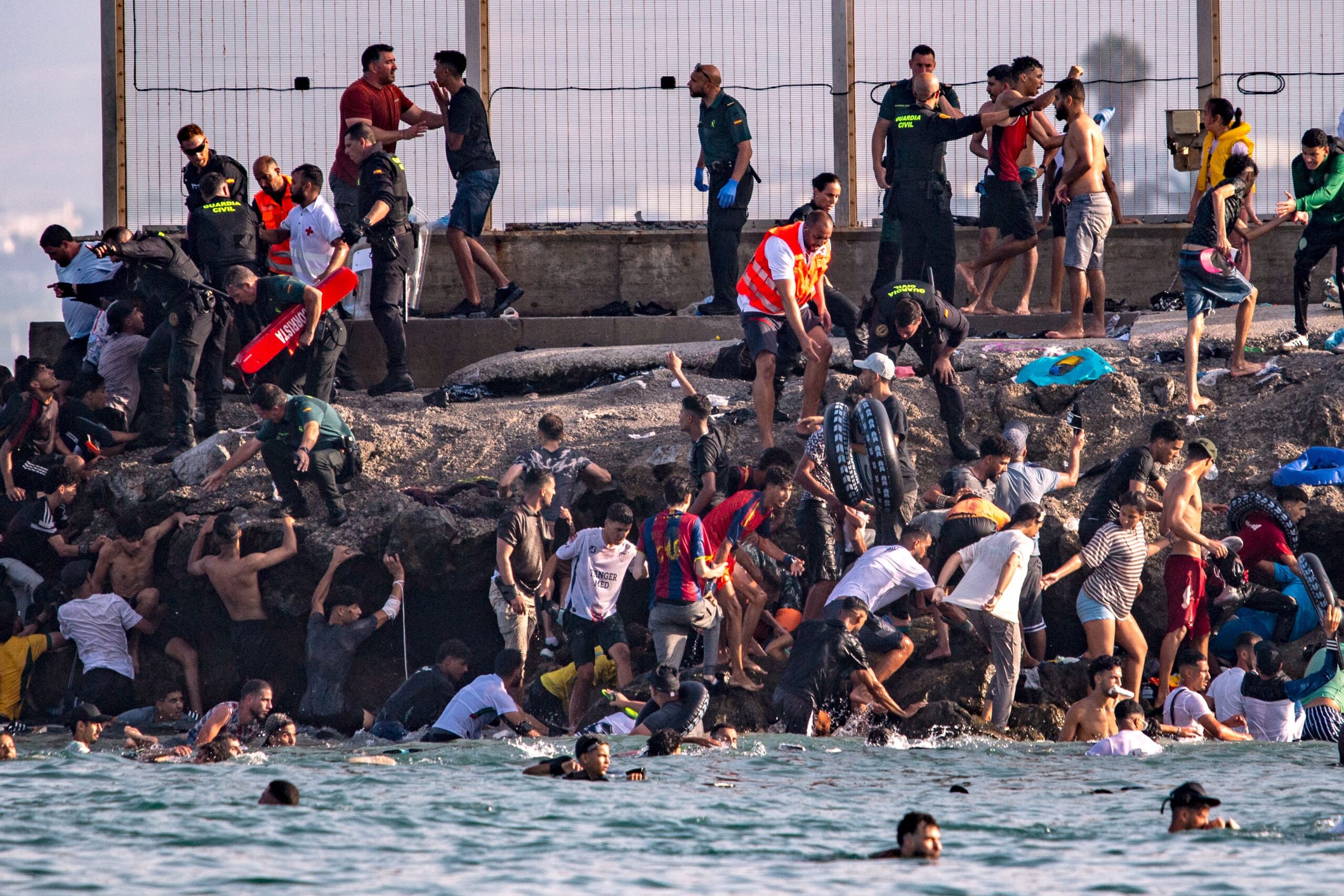
Several European countries have criticized Spain's migration policies.

By Issy Ronald, CNN
(CNN) — The human tragedy was undeniable: around 60,000 desperate people surging across a breakwater barrier from Morocco into the Spanish enclave of Ceuta last Thursday, some drowning and others trampling their fellow migrants underfoot, leaving at least 72 dead.
But while the dramatic incident passed almost as quickly as it had begun, with most of the migrants despondently trudging back across the border, the incident leaves behind a bigger, political crisis that points to future troubles and divisions for the European Union.
The migrants were never going to be able to reach the mainland EU, but that fact was irrelevant to hard-right, anti-migrant politicians around the world who portrayed the incident in apocalyptic terms. And that, in turn, is shaping the response of more mainstream governments, which for the last decade have been fending off those challenges and trying to appeal to voters tempted by populist alternatives.
No matter that the causes of this incident remain unclear, nor that illegal border crossings into the EU have decreased by 37% in the first half of 2026 compared to the same period last year, according to the bloc’s border agency.
The politics of migration are so contentious across much of the continent that several European governments quickly criticized Madrid, and the migration policies of Spain’s Prime Minister Pedro Sánchez.
Italy’s Prime Minister Giorgia Meloni called for Spain’s membership of the Schengen area to be suspended and toughened controls on travel from Spain, while France’s Interior Minister Laurent Nunez ordered extra checks along the countries’ shared border. Finland’s Interior Minister Mari Rantanen accused Spain of “completely failing to protect the Schengen Area’s external border from infiltration,” and even Mette Frederiksen, Denmark’s center-left Prime Minister, urged the EU to “consider all options, including a suspension of Schengen co-operation.” Several EU emergency meetings have been convened or scheduled, including one of the bloc’s interior ministers on Tuesday.
US President Donald Trump went further, labeling the incident an “invasion,” and saying it should be a “talking point for the midterms” as an example of what’s to come if Republicans aren’t elected in November.
“I think Washington’s response to this crisis was to be expected,” said Carla Hobbs, head of the Madrid office at the European Council on Foreign Relations. “What we didn’t expect was this kind of response, and how severe it was, from other EU leaders. It’s genuinely quite rare for member states to turn on one another so publicly like this and over a crisis that never really risked reaching their borders,” she told CNN.
Such a response was likely sparked by two factors, she said. Firstly, far-right parties are surging across the continent, several elections are coming up and Spain “made a very convenient foil” for governments to “talk tough on migration” to their own electorates. Secondly, Sánchez himself, who has made a habit of taking outspoken, principled stances, is a “key factor.”
Spat between allies
Sánchez condemned much of Europe’s reaction as “selfish, polarising and unlawful,” in a letter quoted widely by European media. He pointed out that Ceuta is not part of the Schengen area, singled out Italy as a country that lets in more illegal migrants than Spain, and accused other European states of providing “very little support” to Spain. (Ursula von der Leyen, who leads the European Commission, the EU’s executive arm, said the Commission has “offered support to Spain from the first moment.”)
Sánchez blamed “prejudice, fake news, ignorance or political interest” for this response, adding it was “not only contrary to European law, humanitarian law, and the principles of solidarity that bind us together. It is also contrary to Europe’s long-term interests.”
The spat between Spain and Italy became so hostile that Jose Manuel Albares, Spain’s foreign minister, summoned the Italian ambassador on Friday to discuss comments made by his Italian counterpart Antonio Tajani, who claimed, without evidence, that Madrid’s immigration policy “encourages human trafficking.”
While most other European countries are adopting harder-line stances on immigration, Sánchez has taken a different tack. Earlier this year, his government announced a regularization program initially expected to give 500,000 undocumented migrants already living in Spain a path to legal status, though the number of applications exceeded one million.
“The Spanish policy has been to quite openly embrace migration as a driver of growth,” said Hobbs. “I think behind the scenes, this what other EU leaders know … but they haven’t been able to have that conversation with their public.
“Spanish society has been quite resistant to xenophobia until quite recently …. Now that’s starting to change in the last few years, aided by (far-right opposition party) Vox,” she added.
It is not only on migration that Sánchez has become somewhat of an outlier. He was outspoken in his criticism for US military action against Iran while other European countries attempted to strike a more delicate balance of support and criticism. He has refused to raise defense spending targets to 5% of GDP by 2035, in line with the pledges of other NATO members. And he has pursued a notably more friendly policy towards China than other EU countries.
The mass crossings came in the wake of a recent ruling by Spain’s Supreme Court that authorities cannot summarily deport migrants who arrive by sea without due process. However, experts say that legal decision was extremely narrow, with some arguing it was likely misinterpreted by migrants and traffickers. Sánchez himself blamed misinformation spread by people traffickers following the Supreme Court ruling. Some analysts have also suggested that Morocco may have allowed the influx to put pressure on Spain, pointing out that the incident came just 10 days after Sánchez visited Algeria, Morocco’s arch-rival, and announced a “new phase” in Spanish-Algerian relations.
Whatever the exact knot of causes that led to this, “if you’re any other state watching this, you see that one day of pressure on one part of the EU’s external border and Schengen almost collapses,” said Hobbs. “People start threatening unilateral borders and things like that. If you’re looking at that, you think ‘wow, how cheap it is to bring the European Union down on its knees.’”
The-CNN-Wire
™ & © 2026 Cable News Network, Inc., a Warner Bros. Discovery Company. All rights reserved.
CNN’s Jack Guy, Vasco Cotovio, Jonny Hallam and Alessandra Freitas contributed reporting.
