As Navi Pillay wins Nobel Peace Prize, US takes unprecedented action to cripple the court she served on
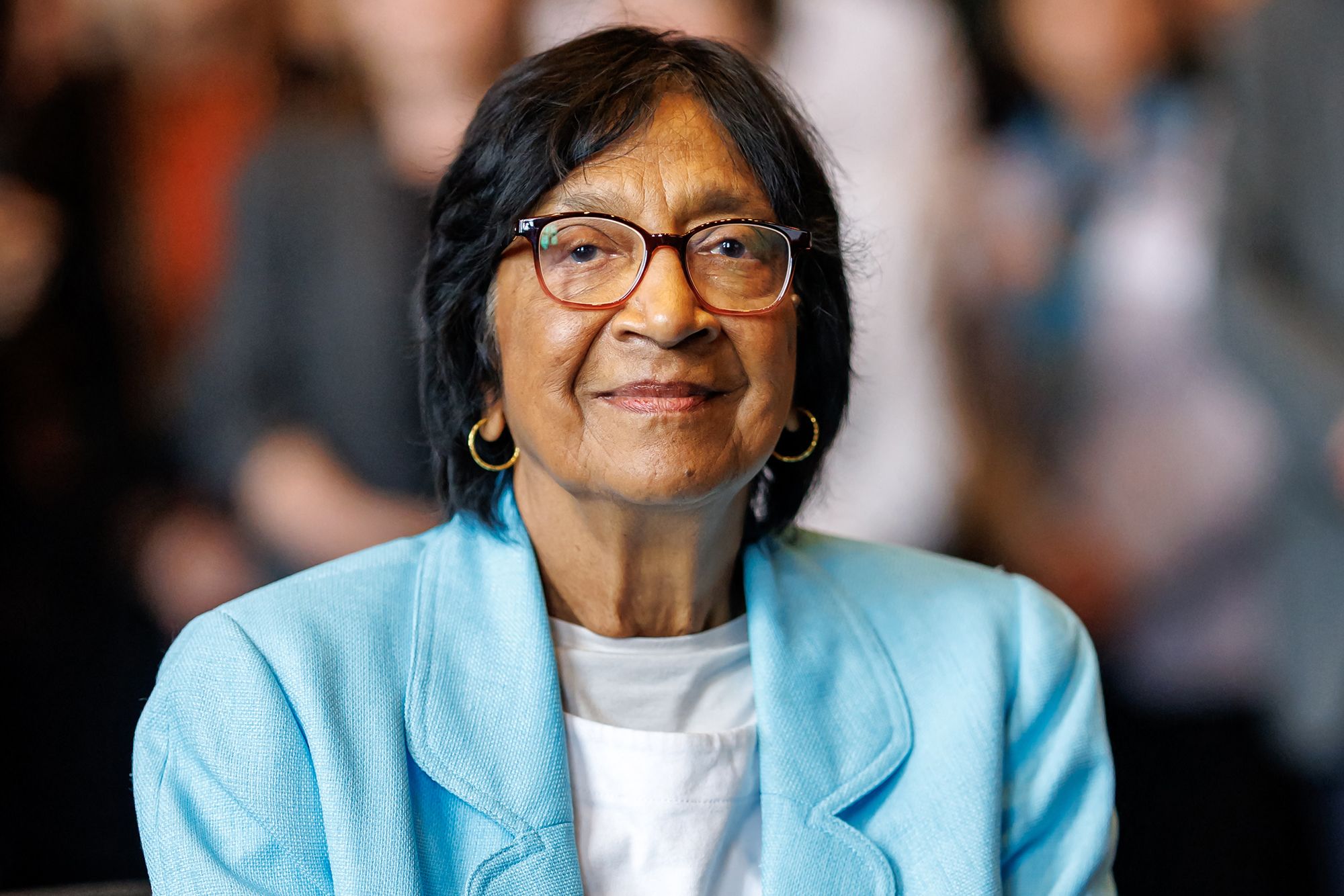
Nobel Peace Prize 2026 winner Navi Pillay at the Nuremberg Forum in Germany on Friday.

By Issy Ronald, Jennifer Hansler, CNN
(CNN) — When South African jurist Navi Pillay won this year’s Nobel Peace Prize, she happened to be at a conference at the Nuremberg Court in Germany, where the landmark trial of Nazi leaders almost 80 years ago laid the foundations for modern international law.
As her colleagues in the human rights community applauded and congratulated the former International Criminal Court (ICC) judge on her win, her first reaction was simply: “Is it true? I thought it must be a joke.”
“If you clap a little bit more, I may share this prize with (US President Donald) Trump,” she quipped, a reference to how last year’s winner gave her medal to the US president, before adding “it’s very appropriate that I’m with friends, colleagues, all of whom support human rights.”
Hours after Pillay’s win, the Trump administration announced fresh sanctions on the ICC, the body established in 2002 to prosecute individuals accused of war crimes, crimes against humanity and genocide.
The work of the human rights community and the international legal order have increasingly come under attack in recent years – a fact the Nobel committee was eager to highlight in its decision to recognize Pillay, 85.
By spotlighting Pillay, who has served on several international courts and oversaw a 2025 UN report that concluded that Israel committed genocide in Gaza, the committee said it wanted to “remind the world that the rule of law – national and international – underpins the system we have set up to ensure peace.”
Justice is a ‘necessity’ for peace
That message was not explicitly directed at any one state. But implicitly, it rebuked those countries – most notably the US – whose actions have weakened international legal institutions.
As part of its efforts to “dismantle” the ICC “brick by brick,” in the words of US Secretary of State Marco Rubio, the Trump administration on Friday announced sanctions on the ICC itself.
“We will ban transactions with this rogue court, cutting off their resources and crippling its ability to operate,” Rubio said in a statement hours after the Nobel Peace Prize was announced.
The measure would cut off the court from US companies and financial services. The US Treasury has issued a six-month waiver for companies to wind down their operations with the court. The State Department said that the six-month window “is intended to provide time” for the court “to demonstrate meaningful progress on diplomatic and legal resolutions that address fundamental US concerns regarding the ICC,” and that it “can be adjusted in response to the success or failure of such efforts to address our concerns.”
The sweeping action faced immediate rebuke from the court and other nations.
The ICC condemned the move as an “assault on the rule of law and on the very foundations of the international legal order,” called on other states to support the court and emphasized that its work would continue.
In a joint statement, the foreign ministers of Canada, Denmark, Germany, France, Italy, Japan, the Netherlands, and the United Kingdom reaffirmed their “continued and unwavering support” for the court.
“As committed supporters of the ICC we regret and strongly disagree with the announcement of sanctions to be imposed upon the court by the United States,” the statement read.
Several of the court’s prosecutors have already been targeted by US sanctions after it issued arrest warrants for Israeli Prime Minister Benjamin Netanyahu and his former defense minister Yoav Gallant in 2024.
Rubio vowed in July to “dismantle” the ICC, accusing it of “waging a war against our country, not with bullets or missiles,” but with “the force of so-called international law.” Neither the US nor Israel are parties to the court, and Washington has challenged its jurisdiction to investigate either country.
The administration’s ire against the ICC goes back to Trump’s first term, when it targeted the court for seeking to investigate alleged war crimes committed by US forces in Afghanistan. The second Trump administration has imposed a slew of sanctions against ICC officials for their attempts to investigate the US and Israel.
Without referencing these efforts, the Nobel committee warned that international law is “an absolute necessity” for peace, even if it has struggled to hold the world’s most powerful actors responsible for their actions.
“History has shown that a world operating without the rule of law is unjust, unwise and inhumane,” the committee continued. “The judges – those who guard the thin red line between order and chaos – are therefore highly deserving of our praise. But today, as these same judges are sanctioned, and their institutions are attacked.”
Pillay, who has served as a judge at both major international courts and as the UN human rights chief, embodies many of the values the committee wanted to emphasize. She too warned that international law, the ICC in particular and human rights are under attack, undermining the principle that justice is required for lasting peace.
The choice was a brave one, Haakon Gjerløw, acting director of the Peace Research Institute Oslo, told CNN. “It is big political actors that are pushing against some of these institutions, against some of the legal orders.”
Choosing an individual, rather than the institutions for which she works, “shows that we as individuals might work towards peace in our different capacities,” Gjerløw added.
An anti-apartheid lawyer
Born on September 23, 1941, Pillay grew up in a family of Indian Tamil origin in Durban, South Africa, while the country was still under apartheid.
Donations from her local community helped her enroll in classes for non-white students at the University of KwaZulu-Natal and it was there that she first came across transcripts of the Nuremberg Trials. They transfixed her, both by demonstrating the idea of countries coming together to pursue criminal justice and as a framework to understand apartheid-era crimes.
After graduating, she defended anti-apartheid activists, exposed the torture of political detainees and successfully sued to stop her own detained husband from being tortured.
“I won access to lawyers for political prisoners, including Nelson Mandela,” she wrote in a 2021 CNN op-ed. “The first judge’s chambers I entered was my own, in 1995, as the first non-White woman to serve on the High Court.”
However, she never served her full term on South Africa’s High Court as she was elected by the UN General Assembly to be a judge on the International Criminal Tribunal for Rwanda, which sought to prosecute those responsible for the Rwandan genocide in 1994.
Pillay was instrumental in two significant legal precedents set by that tribunal – firstly, that rape and sexual violence could constitute a crime against humanity and genocide, and secondly, that a defendant could face “charges of incitement to commit genocide purely on the basis of spreading propaganda,” the Nobel committee said.
She served as a judge at the ICC from 2003-2008 before being appointed as the UN human rights chief. She is currently a judge at the International Court of Justice in a case where Myanmar has been accused of genocide.
The Nobel committee’s decision to award Pillay the peace prize triggered a backlash from Israel on Friday, which has strenuously denied allegations of genocide.
Netanyahu condemned the Nobel committee, saying it had “lost its moral compass” and accusing Pillay of “lies.”
There has been no reaction yet from Trump, who has made no secret of his desire for the prize.
In an impromptu speech in Nuremberg on Friday, Pillay dedicated her Nobel Prize to “all of the survivors of international crimes” and to those defending international criminal justice “whose compassion and courage continue to ensure that impunity will not be allowed to reign.
“Perhaps it was meant to be that I was in this historic courtroom 600 where the Nuremberg Trials were held when the announcement was made and I was informed of the award.”
The-CNN-Wire
™ & © 2026 Cable News Network, Inc., a Warner Bros. Discovery Company. All rights reserved.
CNN’s Lauren Kent, Arina Porkhovnik, Dana Karni, Jo Shelley and Lauren Said-Moorhouse contributed reporting.
