‘Through the roof’: This county has the highest average gas price in America
Connie Lear gets around her small town of June Lake

By Chris Isidore, CNN
(CNN) — For Connie Lear, driving even her hybrid car is a luxury she can rarely afford.
Lear lives in the rural town of June Lake, California, a picturesque community of 300 people near Yosemite National Park and the Nevada state line.
June Lake is part of Mono County, which has the highest average gas price in the United States.
“My husband and I were watching the news this morning, and it came on about $4 gas and I said, ‘Well, where are you? Ours is $7.50!’” she said, citing the price at the only gas station in her town. The Mono County average was $6.72 as of Monday, according to AAA.
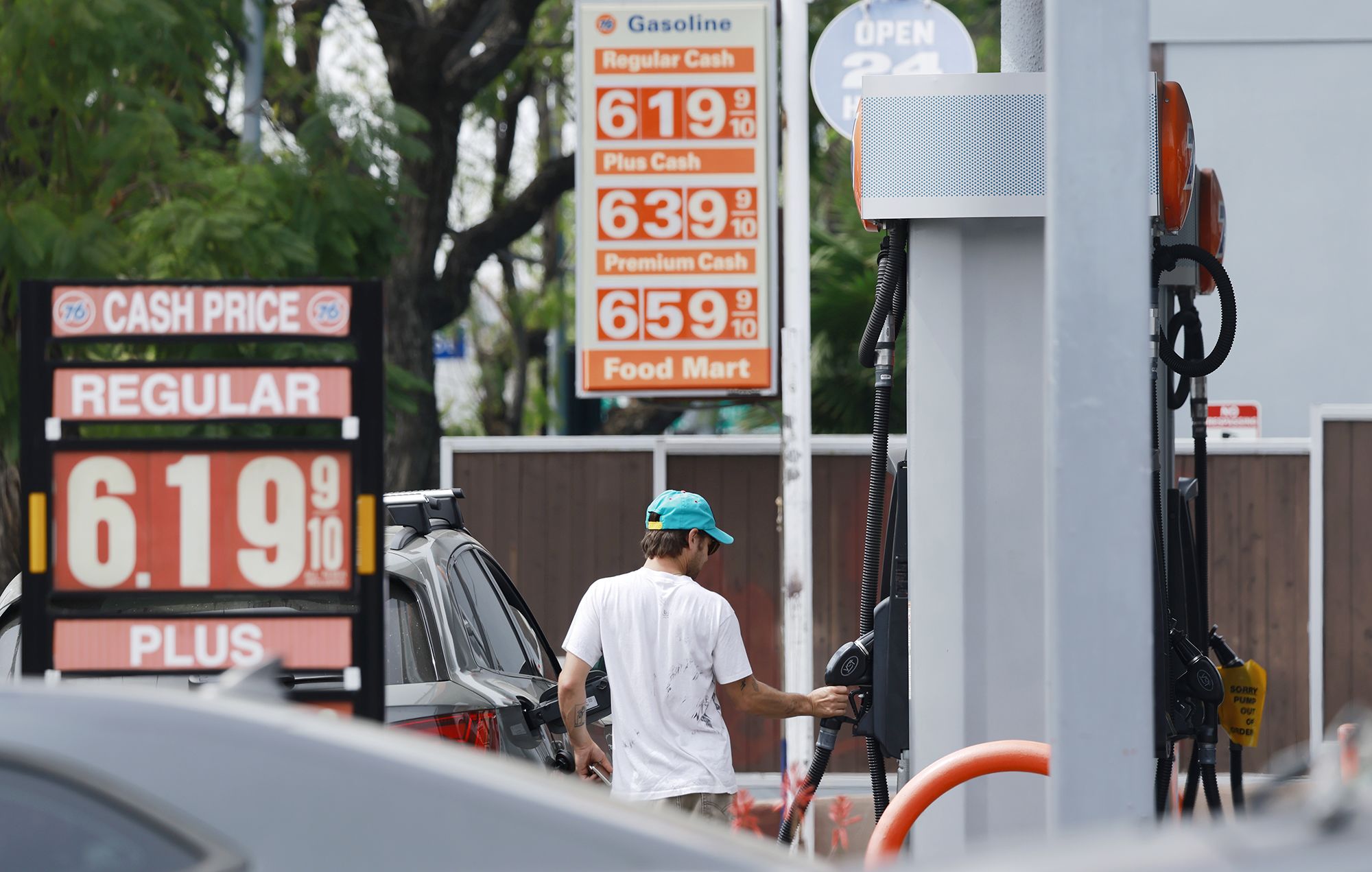
Like many rural counties across the country, Mono County faces rising gas prices from a higher cost to transport fuel there, limited demand and reduced competition. But it’s also located in the state with the most expensive gas in the nation due to a combination of taxes, fees, regulations and the closure of many local refineries.
Gas prices are only getting higher as the US-Israel war with Iran drags on, up $1.14 nationally since the start of the war. In California, the cost is $1.29 higher.
For Lear, she limits trips to the nearest grocery store 20 miles away to once a week. She uses a bicycle or golf cart instead of driving to check on the 42 vacation rentals she manages around town.
If she needs to refuel her hybrid Ford Explorer, she often will drive 120 miles to cross into Nevada where the gas was “only” $4.57 the last time she filled up. Still, the cost is the least of Lear’s worries. She’s concerned high gas prices will keep away the summer travelers that are crucial to her town’s economy.
She said she is already noticing a decline in bookings.
People who used to reserve a week are now booking four or five days. Lear said the same thing happened in 2022, when Russia’s invasion of Ukraine spiked gas to a record $5.02 a gallon nationwide and much higher in Mono County.
“It seems like it’s going to be the same as it was then, maybe worse,” she said.
The reasons rural drivers pay more
Small rural towns across the country generally pay a higher price for gas than more populated metropolitan areas.
There are fewer low-cost gasoline retailers like Costco available to help drivers keep prices in check. But getting gas delivered over long distances is also expensive.
A tanker truck has to drive four and a half hours over 200 miles to deliver gasoline from the closest wholesale terminal in the state to Mono County. That long trip is costly, particularly for gas station owners.
Just down the road from June Lake is the town of Lee Vining, where Shelly Channel runs a Shell station. The sign outside advertises $6.85 for regular gas. It was only $5.69 before the start of the war in Iran.
Channel is a great-grandfather who started selling gas in 1978 when it was only 50 cents a gallon. He said that despite all his years in the business, the current gas spike doesn’t make any more sense to him than it does to his customers.
“It’s not like there’s any shortage of oil. I’m old enough to remember when there was rationing,” he said. “There’s no rationale as to why the prices from the day the war started have just gone through the roof.”
Rural station owners also don’t sell as much gas – they may sell as much in a month as one in a city or busy suburb might in a day. That means the fixed cost of running a station is spread over a much smaller number of gallons sold.
Channel said he held off raising prices for the first two weeks of the war in Iran as prices soared nationwide. But after a gas delivery on March 12, his first since the start of the conflict, he had to raise his price $1 a gallon that day due to the higher wholesale price he was forced to pay.
“My margin, my markup, is exactly the same as it was before this all started,” he said.
In the summer, he sells about 50,000 gallons of gas in a month. In November and December, “I’m lucky if I do 5,000.”
Those low volumes make it difficult for rural station owners to be profitable, said Tom Kloza, an independent oil analyst who works as an adviser for Gulf Oil.
“If you can do 200,000 gallons of gasoline a month, that’s the sweet spot,” Kloza said. “If you’re only doing 50,000, it’s tough, and boy, if you’re doing less than 50,000, it’s going to be really tough.”
California’s highest prices in the nation
Drivers are grappling with higher prices in rural areas across the United States. But those in California face an even greater challenge – the state has the most expensive gas in the nation. The current average is $5.93 a gallon statewide.
California has the highest state gasoline tax, at 71 cents per gallon. Gas prices are derived from a variety of components: the price of crude, refining and transportation fees and taxes. But it’s the state’s environmental rules that lead to a variety of other costs.
There’s an additional carbon tax, unique to California, that can add another 20 to 25 cents per gallon. And regulations requiring cleaner burning gasoline can tack on an additional 25 cents.
The closure of multiple refineries across the state has also cut the supply of domestic gasoline. A Los Angeles-area refinery closed in December, and a Bay Area one is due to shutter this month. That will leave the state with just six refineries to serve 28 million California drivers.
New regulations under consideration could add an additional $5 billion to $9 billion in annual costs to refineries that operate in the state, according to Jodie Muller, CEO of industry trade group the Western States Petroleum Association. These costs could force more refineries to close in the coming years, she said.
That could make the state even more dependent on imported gasoline. And those prices should stay elevated for some time, even if the war in Iran ends and oil shipments start to flow again through the Strait of Hormuz.
California authorities blame soaring oil prices for the price hike at gas stations, noting that refinery closures “are not unique to California.”
“The price of crude oil is the biggest factor affecting gas prices, which makes the war in Iran the primary driver of price spikes at pumps in California and around the world,” said the California Energy Commission in a statement Wednesday.
But none of that is top of mind for the 9,200 drivers who live in Mono County.
Station owner Channel said his customers understand he’s not the one getting rich off the rising price of gasoline.
“That’s not to say they don’t have a coffee and gripe about the price of gas hurting everybody,” he said. “But they don’t direct it at me.”
Lear said she likes living in a quiet community and wouldn’t consider moving from the town she’s lived in for 38 years. But staying there does present its challenges, especially during gas spikes like this one.
“We do whatever we can think of so we don’t have to drive our car,” she said. “We can’t afford to spend $7.50 to drive around town. It’s ridiculous.”
The-CNN-Wire
™ & © 2026 Cable News Network, Inc., a Warner Bros. Discovery Company. All rights reserved.
