Two key takeaways from the Fed’s unusually unpredictable meeting
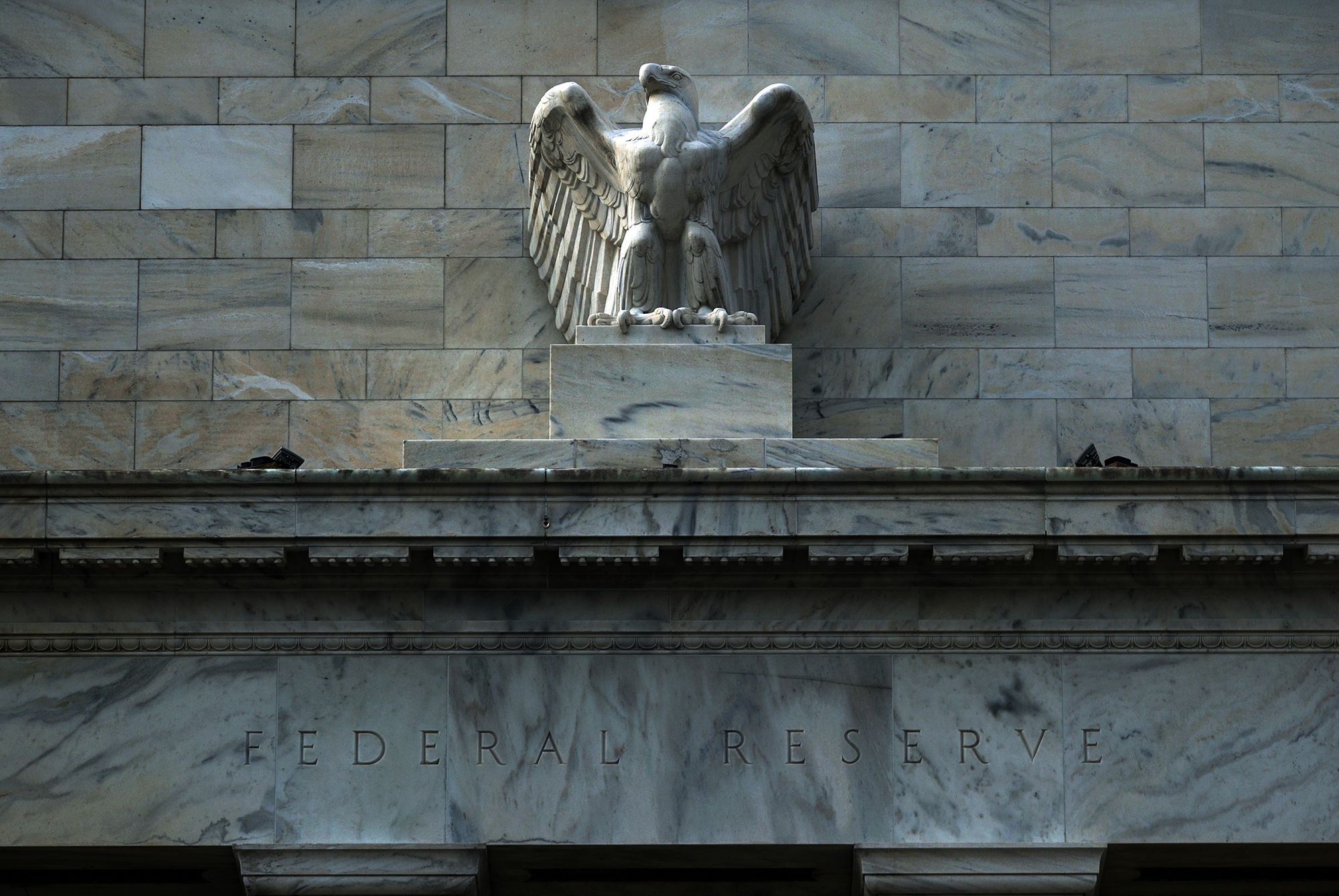
The eagle statue sits on the Marriner S. Eccles building of the Federal Reserve Board on August 6

By Bryan Mena, CNN
Washington (CNN) — Federal Reserve Chairman Kevin Warsh is already getting the “family fight” he has called for, and he’s leaving it up to Wall Street to choose between dueling narratives.
The Fed on Wednesday held its benchmark lending rate unchanged at a range of 3.5%-3.75% for the fifth consecutive meeting, with the persistent conflict in the Middle East clouding the outlook for inflation.
Unsurprisingly, the Fed’s latest decision was not unanimous, with Fed presidents Beth Hammack of Cleveland, Neel Kashkari of Minneapolis and Lorie Logan of Dallas dissenting in favor of a quarter-point rate hike instead — policymakers who have already signaled that the Fed must be tough on inflation.
The latest dissents for rates to head in one direction were the most since September 2016, but Warsh said he doesn’t see that as a bad thing.
“I asked for a good family fight and I got one,” Warsh told reporters in a post-meeting news conference. “It was an active, robust discussion about what’s in the full range of what we can do and might want to do in the period ahead.”
Wall Street, however, is already convinced the Fed’s key interest rate is heading higher, with investors increasingly expecting more than one rate hike by year’s end, potentially doing some of the Fed’s work in pulling on the economy’s reins. Long-term interest rates have already moved higher, including the benchmark yield on the 10-year US Treasury note, which the Fed doesn’t directly control. Warsh has argued that markets should play a larger role in assessing the US economy and shaping financial conditions.
“Markets have made decisions because we stepped back from trying to influence,” Warsh said, adding that it’s crucial for the Fed to not get the market’s perspective “all fogged up by giving it our own forecast.”
Here are two key takeaways from the Fed’s latest decision that turned out to be “all bark, no hike.”
A new view on the role financial markets play
Ahead of this week’s meeting, there was an unusual lack of clarity about the Fed’s next move due to a muddled inflation picture and Warsh not weighing in on what it all means. That threw investors for a loop, with markets split on whether there would be a hike or another pause.
Since 2000, Fed officials, including the Fed’s head, have dropped hints through public comments on what they’ll be deciding, a practice known as “forward guidance.” Markets became accustomed to that guidance, but now they’re being weaned off it because times are different, according to Warsh.
“In a lot of countries, coming out of the 2008 crisis, we were in crisis mode, we were purposely providing a lot of information, trying to provide a lot of assurance, trying to tell people exactly what we’re going to do,” Warsh said. “In crisis mode that strikes me as a very prudent policy, but in more benign conditions, it strikes me as worth revisiting.”
Warsh, however, said markets won’t be dictating what the Fed ought to do.
“We’re not going to be constrained by market prices,” he said. “We’re not going to be constrained or take verbatim from what the market’s doing but I think it’s useful to understand that markets can be a very good source of information.”
The problem is that markets don’t always get it right, such as during the burst of the dotcom-era financial bubble.
‘A full range of alternatives’
Throughout his news conference, Warsh stressed that he welcomes different perspectives on the economy — both within and outside of the Fed.
“Surprises are not the objective, but at the same time, I would say we didn’t come into this meeting feeling constrained by the full range of alternatives we had in front of us,” he said.
There have indeed been mixed signals on the economy, making it difficult to make sense where rates should be headed: Recent data showed that inflation eased sharply in June, but the ongoing war with Iran war has pushed global energy prices higher. Without a permanent solution, which would likely restore shipping traffic through the region, the global energy market remains destabilized. Such a scenario would raise the risk of inflation pressures broadening, such as by pushing up airfares and freight costs — a point that Warsh raised. Fed officials are also assessing how the rapid adoption of AI could affect inflation.
Before Warsh took on his new role at the Fed, the prevailing view among officials was that any uptick in inflation driven by the Iran war would likely be temporary, rendering rate hikes unnecessary. The argument was that energy price spikes are volatile and eventually reverse without any action from the Fed. Central bankers have also emphasized that interest rates work with a lagged effect on the economy.
It’s unclear if the majority of officials still hold that view, though the policy statement said inflation has moved higher “in part reflecting supply shocks” related to the Iran war. The Fed’s rate decisions are geared for the demand-side of the economy only. Warsh didn’t share his view on that dynamic, nor did he provide his outlook for inflation or interest rates.
He said what’s important is that officials agree that inflation must be tamed: “There was a lot of agreement that I heard that we have the powers, the tools, and the authority to deliver stable prices. No walking back from our responsibilities.”
For now, markets are clamoring to make sense of the Fed’s reaction function under the new chairman. Critics of forward guidance, including Warsh, say the practice is less useful in times of high uncertainty, such as during an unpredictable war that’s having a destabilizing effect on the global economy. Others argue the lack of forward guidance from the chairman could be counterproductive.
“Chair Warsh has been studiously uncommunicative about how the Fed is going to react to these changes in economic conditions,” said Narayana Kocherlakota, an economics professor at the University of Rochester and former president of the Federal Reserve Bank of Minneapolis. “It’s going to lead to market volatility.”
“It makes businesses more reluctant to invest, meaning they’ll be less likely to demand workers to build the kinds of goods and services … because they’re uncertain about what the Fed is going to be doing,” he added.
This story has been updated with new developments.
The-CNN-Wire
™ & © 2026 Cable News Network, Inc., a Warner Bros. Discovery Company. All rights reserved.
