Gustavo Dudamel arrives in New York with a mission that goes beyond the podium
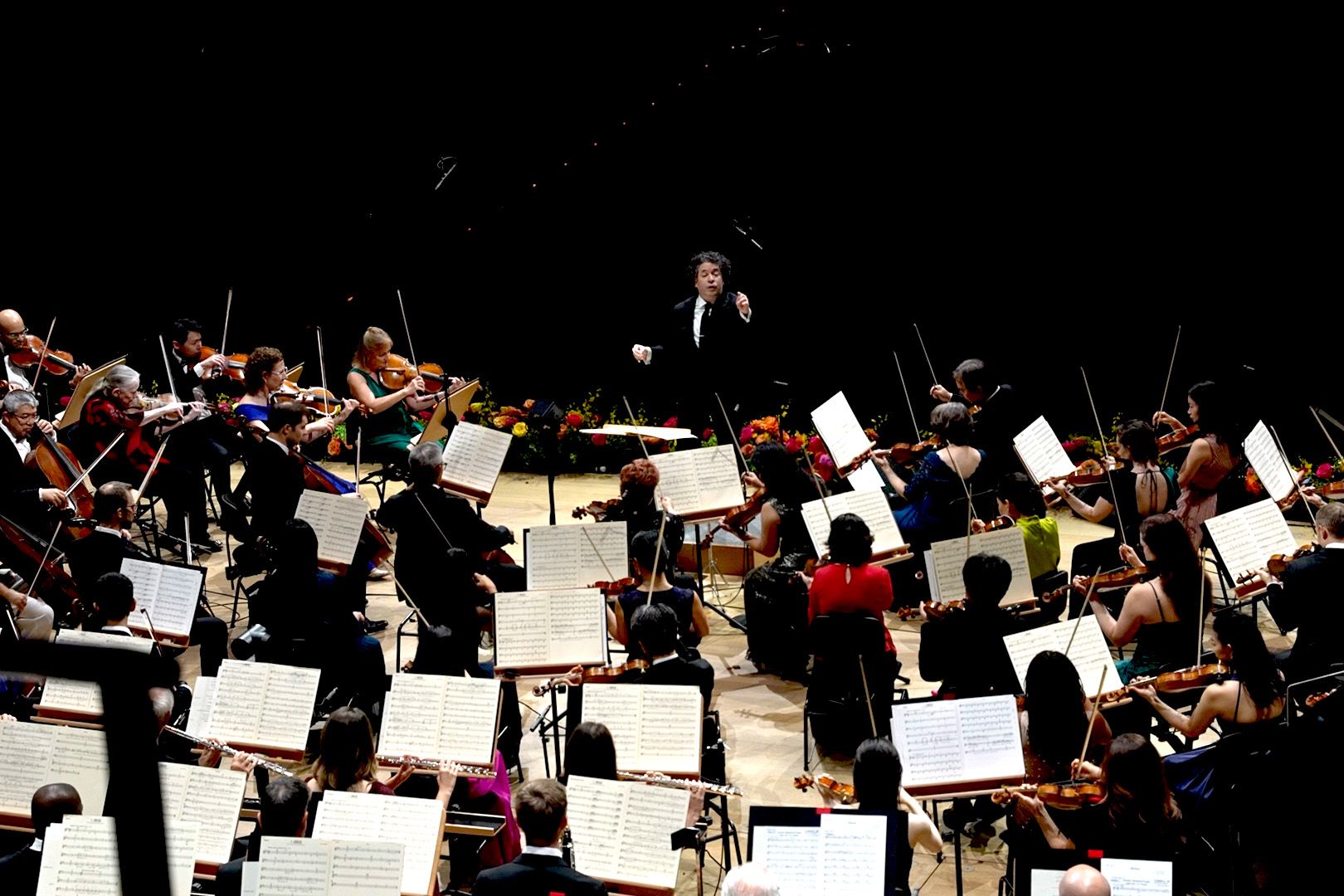
Gustavo Dudamel

By Max Feliu, CNN
New York (CNN) — It was a star-studded gathering at Lincoln Center, with the likes of Steven Spielberg and Alec Baldwin toasting New York’s new Philharmonic director with champagne, arepas and the din of salsa music.
It’s been a while since the city’s cultural elite has buzzed as it has with the arrival of Gustavo Dudamel, 45.
Dudamel, or “The Dude,” as he was known during his 17 season-run at the helm of the Los Angeles Philharmonic, was a force in LA, both on the stage and in his efforts at tackling the age-old issue of democratizing an artform often seen as elitist. Dudamel broadened the Philharmonic’s reach through educational programs and crossovers with popular culture, notably appearing at the halftime show at the FIFA World Cup final, and conducting scores for films like “West Side Story” and “Star Wars: The Force Awakens.”
Now, he has arrived in New York with a similar mission, and has spoken from the beginning of his belief that music is a “fundamental right.”
“You really have to take the risk,” Dudamel said in an interview this summer. “To really make people feel that they belong.”
Music for the people
Dudamel’s sensibility was forged as a child growing up in the Venezuelan city of Barquisimeto, where he learned to play violin through El Sistema, Venezuela’s National System of Youth and Children’s Orchestras and Choirs. The program was founded in 1975 by José Antonio Abreu, a musician and economist who believed that classical music — long reserved for a select few — could transform the lives of Venezuela’s poorest children. Since its founding, more than one million people, according to official Venezuelan figures, have taken part in the program, which operates in community centers and offers free instruments and lessons to children, most of whom come from low-income families.
“What my colleagues in Venezuela understand about music is that it’s not just decorative, it’s not just extracurricular, and it’s not just fun, although it is fun,” said Anne Fitzgibbon, founder and executive director of the Harmony Program, a New York City nonprofit that provides free music education to children in underserved communities. Fitzgibbon drew inspiration to create the program after studying El Sistema in Venezuela on a Fulbright fellowship in 2007.
El Sistema was founded decades before Hugo Chavez came to power in a populist revolution that quickly turned authoritarian. He and his successor, Nicolás Maduro, continued funding the program, and so its ties to the state have drawn scrutiny. For years, critics also questioned Dudamel’s silence about Chavez and Maduro and the human rights abuses and corruption that marked their reins. Dudamel broke his silence in May 2017 after a young musician was killed during a protest.
“I raise my voice against any form of repression,” he wrote at the time in an open letter. “Times cannot be defined by the blood of our people.”
Speaking to CNN this summer, Dudamel praised El Sistema. “It’s not a musical factory system,” he said. “El Sistema is using music to transform the lives of children.”
‘Deep listening’
Dudamel has landed in a city with several programs inspired by El Sistema’s model.
Around the US, some 150 organizations inspired by El Sistema — ranging from community programs to YOLA, the youth orchestra Dudamel helped found in Los Angeles — teach music to more than 30,000 students, according to El Sistema USA, the network that connects them.
Carlos Sánchez was just 13 when he first performed alongside Dudamel at a concert in his native Maracaibo, Venezuela’s second biggest city. Years later, after studying bass through El Sistema, he toured the world with the Simón Bolívar Symphony Orchestra under Dudamel’s baton.
Now he is the director of UpBeat NYC, a community music center in the South Bronx offering free music education for 230 students aged 5 to 21.
“When I first came to UpBeat, I saw how the program worked with the children. It was what I was feeling back in my country,” Sánchez said.
Funded by private donations and grants, UpBeat also helps families with food and support during difficult times. “It’s not just asking a kid whether they practiced,” said Sánchez. “It’s asking, ‘Are you hungry? Is everything okay at home?’”
Now, groups like UpBeat hope Dudamel’s arrival will bring more attention to them and allow them to grow.
“He’s bringing power to a few levels that we’re interested to see how he utilizes,” said Richard Miller, the program’s co-founder and co-executive director. “We’re going to be there trying to be in his ear to make sure it’s going to the families that we represent and work with.”
Following Dudamel’s appointment, the Philharmonic’s co-chairman, Oscar L. Tang, and his wife, Agnes Hsu-Tang, donated $40 million to advance music education and bring orchestra to new audiences.
“In our generation, we’ve not had a music director that has been both equally committed to what’s happening at the podium, as he is with what is happening in the schools,” said Gary Padmore, the New York Philharmonic’s Vice President for Education and Community Engagement.
Padmore acknowledged that New York’s school system remains deeply segregated and said his team is targeting the city’s “arts deserts,” such as Corona in Queens and Canarsie in Brooklyn. Change will take time, he said. Dudamel will be with the orchestra for only about 15 weeks a year, and Padmore described a conductor’s first season as a period of “deep listening.”
Miller, of UpBeat, tempered his enthusiasm with caution. The issues run deep — he noted that the orchestra must still diversify and that Afro-Latino artists fought for decades to broaden classical music’s audience and that Lincoln Center itself was built on San Juan Hill, a neighborhood whose Black and Puerto Rican families were displaced to make way for it.
A few miles from Lincoln Center, Sánchez said he hoped Dudamel would inspire UpBeat’s students, just as the conductor once inspired a young Sánchez in Maracaibo.
“I didn’t know any of this until they came to me,” he said. “I hope with all my heart that he can come and bring the same hope.”
The-CNN-Wire
™ & © 2026 Cable News Network, Inc., a Warner Bros. Discovery Company. All rights reserved.
