Why baseball teams party so hard and so often in October
The Cleveland Guardians' Steven Kwan celebrates in the clubhouse after defeating the Chicago White Sox to advance to the American League Championship Series.

By Don Riddell, CNN
(CNN) — Toward the end of every regular season, if it’s been a good one, the Boston Red Sox will receive a special package from one of their kit suppliers: 100 pairs of goggles.
It’s an unusual gift for a baseball team, but each playoff round brings another shipment of 100 more pairs of eyewear until they reach the World Series.
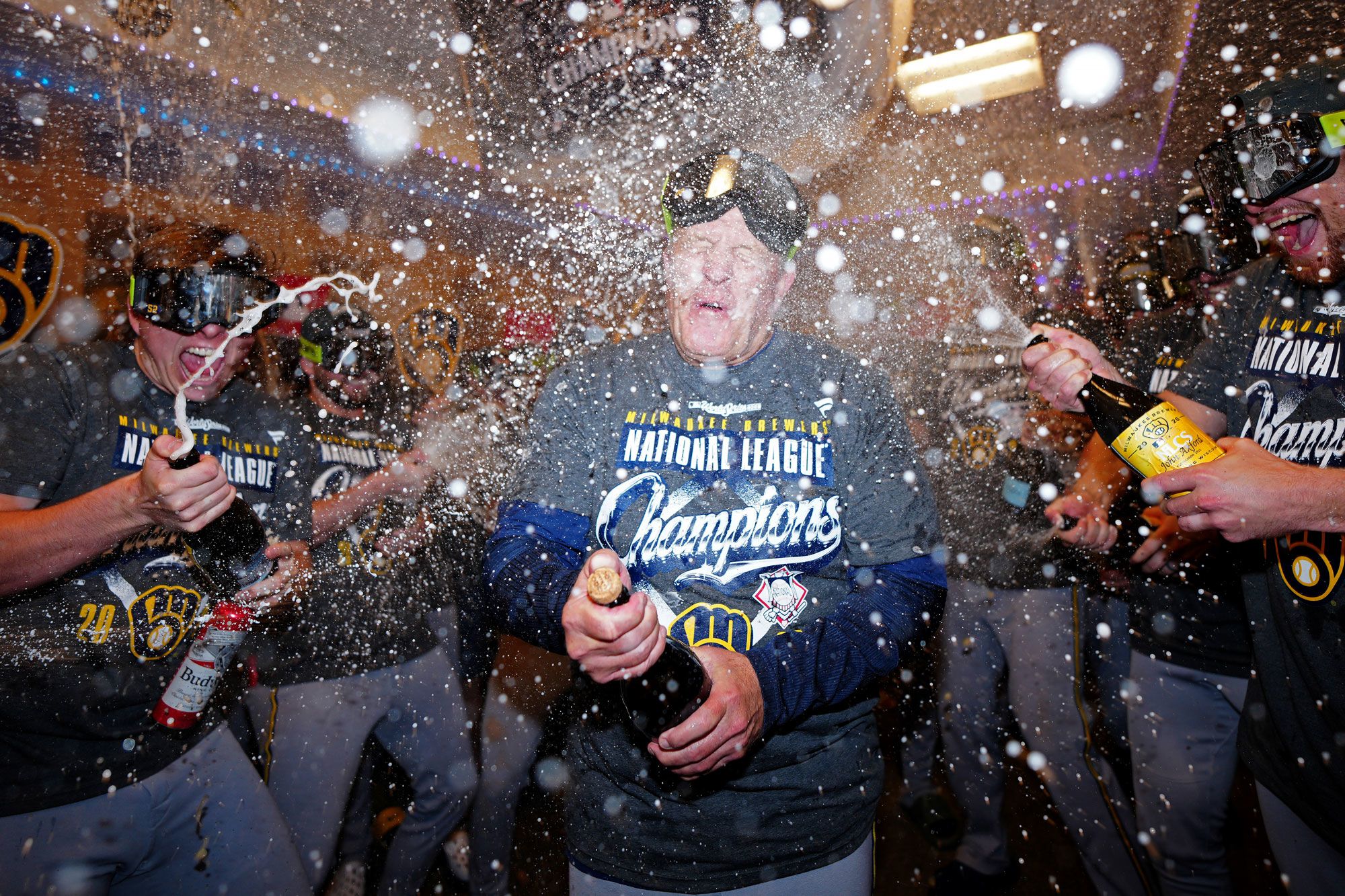
The reason? Champagne sprayed at point-blank range at high velocity into the face will sting your eyes, and baseball players tend to do a lot of that when they’re winning.
Every major US sport has multi-round postseason schedules, but none of them party like MLB teams. Locker room celebrations in the NFL tend to be subdued until the Super Bowl, and since hockey players are famously superstitious, popping bottles early is practically verboten in the NHL; the Stanley Cup is all that really matters.
Clubhouse manager Tom McLaughlin has spent over 40 years with the Red Sox, and he says he’s lost track of how many celebrations he’s been involved in, but he counts them in the dozens. He told CNN Sports it was “pretty tame” when he started in the ‘80s, when the postseason was much shorter, but the back end of the season now can feel like one enormous bender for the most successful teams.
Clinched a playoff spot? Party.
Successfully navigate the wildcard round? Let’s get wild.
Made it through the Divisional Round? Get another round in.
Won the Championship Series? We’re going on a spree.
By the time a baseball club wins the World Series, let’s just say that the celebration will not be their first rodeo. Everyone will have had plenty of practice.
One of McLaughlin’s jobs is to procure the booze. Another is to try and keep the bubbly off everybody’s personal belongings, the furniture, TVs and audio equipment. Look closely at any video footage in the aftermath of a clinching victory and you’ll see protective plastic sheeting everywhere. It resembles the “kill room” in the TV show “Dexter.”
It takes two hours to get all the safeguarding stuff in place, and if it looks like things are going sideways on the diamond, the staff will be waiting, mid-ladder, for the call to rip all the plastic down.
For a series win, such protection is essential.
“That first hour is intense,” McLaughlin told CNN Sports. “It’s crazy.”
“Earn the burn”
Expensive bottles of Moët & Chandon or Dom Pérignon are revved up in the revelry and everyone and everything gets soaked.
“It’s very wet. It’s sticky. If you have like a paper cut or a scrape, it’s getting in there,” explained former slugger Curtis Granderson to CNN.
“It turns into like a playful water gun fight. Everybody gets their ammunition with their bottle of champagne, and then you’re shaking it up to make it just amped up, ready to go. And whether you’re spraying it to hit the ceiling, hit a couch, hit a teammate, hit a reporter, do it to yourself. Everything is a target within the locker room.”
Targeting somebody for a soaking is a sign of respect. After playing a key role in the Cleveland Guardians’ Wild Card series comeback against the Chicago White Sox, Steven Kwan was barely able to speak with a reporter in the clubhouse.
“I mean, no! God, no!” he gasped as suds were poured all over his head. “It’s so cold! I feel like I’m being targeted right now. I’m in the ring. I’m trying to survive, but this is a ton of fun.”
Granderson recalled that of the 12 to 15 clubhouse celebrations he was involved in, he doesn’t remember drinking any of the champagne.
“I think I was mostly spraying it,” he said. “It was around my face and mouth, so I tasted it. I didn’t actually pour it up and drink it though.”
Granderson says he treasures some of the goggles from those celebrations in his trophy cabinet, but others prefer to engage all five of their senses during the celebration.
“A teammate of mine, Michael Cuddyer, he was the one saying you got to ‘earn the burn,’” explained Granderson. “He would always go with no goggles because he loved the fact that it burned his eyes. Because, to get a chance to do that meant you were doing something well.”
Sometimes, it’s not just the booze.
McLaughlin says he remembers the New York Yankees celebrating a series victory at Fenway in the ‘90s and food, milk and yogurt were thrown around. They even dragged the hose out of the shower for good measure.
“The Yankees of the ‘90s did not get cheated when they had fun,” he said, acknowledging the scale of the mess they had to clean up between the end of the party and sunrise.
“If you were in a hotel lobby, it would be a lot different,” he laughed. “I’m sure the police would be involved.”
Making their mark
Every year, as the postseason approaches, a carpet-cleaning company in Boston knows to stand by; if a series is clinched, they’ll be called in for a shampooing assignment at 2 a.m.
The clubhouse managers try to protect as much of the property as possible, but there is only so much they can do.
“No matter how much you clean it, it smells horrible for days,” McLaughlin said, adding that the ceiling tiles turn brown, almost black, and must be replaced.
So why does baseball find these celebrations so irresistible? McLaughlin ponders the question: “I don’t know where it came from, I really don’t, I wish I had the magic answer.”
He begins thinking out loud, recalling the players and teams that he’s seen redecorate his clubhouse so enthusiastically over the years.
Eventually he settles on the idea that success can be so fleeting, “You could be a player that came up and only had an impact in one game – you might never be in the Major Leagues again. So, I think when you have the opportunity to celebrate, to appreciate where you’re at, why not?”
Baseball is a high-pressure psychological game where the difference between success and failure is razor-thin, and the players are trained to keep their emotions in check. Teams are tight-knit, spending practically every moment together from Spring Training through October in what can be described as a 162-game marathon.
So perhaps it makes sense to view a party after clinching a pennant or a place in the postseason as more of a release of all the pent-up stress, a relief that the season wasn’t in vain.
Sure, you might be celebrating another triumph in a week’s time, but the end of the road might come just as quickly, and you may never see some of your teammates again.
Granderson doesn’t believe that repeat celebrations diminish the significance of the ultimate prize, the World Series.
“It’s like birthdays,” he mused. “We have our first birthday – is that one more important than the 16th? Is that one more important than the 21st? Is that one more important than the 50th? They all have their special moments.”
McLaughlin agrees with the sentiment, adding a caveat.
“The big thing is at the end of each series when you win, you get a hat and T-shirt on the field that says division champ, American (League) champ; people want those so bad,” he said. “But when you get one that says world champ, you don’t even know where the other ones are.”
However, there might be one exception.
In 2004, the Red Sox swept the St. Louis Cardinals 4-0 to win their first World Series since 1918, ending the so-called 86-year Curse of the Bambino. But McLaughlin recalls it wasn’t the biggest celebration of that postseason.
In fact, it was in the previous round, when they clawed their way back from 3-0 down against their fiercest rivals, those pesky Yankees, and clinched the series in New York. It was the first, and remains the only time an MLB club has dug themselves out of such a deep hole.
That was the party everyone remembers in 2004.
That was also the season David Ortiz says that he introduced the idea of wearing the protective goggles to his Red Sox teammates.
Now, when any baseball player looks back on the best nights of their careers, they’ll hopefully remember how good it all looked, even if they needed goggles to see it.
The-CNN-Wire
™ & © 2026 Cable News Network, Inc., a Warner Bros. Discovery Company. All rights reserved.
