What we know about the Trump-backed IndyCar race taking over the heart of DC
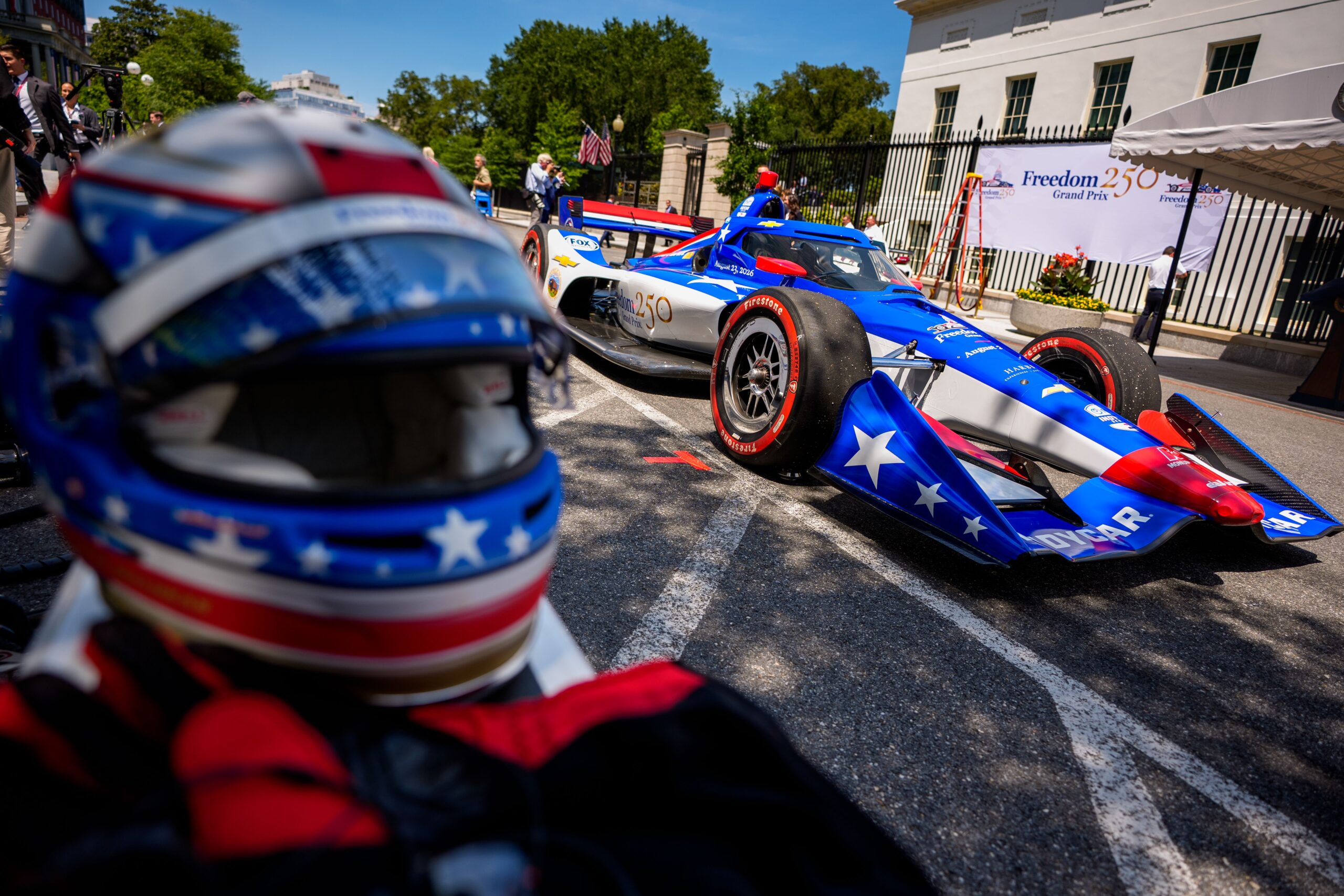
Grand Prix crew members work during a showcase at the White House on July 13.

By Aleena Fayaz, CNN
(CNN) — Monaco, Las Vegas, Detroit, and Miami have boasted high-speed street races — and soon, Washington, DC will too.
Race cars will push speeds up to 180 miles per hour this weekend as the nation’s capital joins other iconic cities hosting street circuits, where public roads are converted into a race track. In DC, the Freedom 250 Grand Prix is part of a belated celebration of the nation’s 250th anniversary and President Donald Trump’s continued efforts to transform Washington.
In a first-of-its-kind event for DC meant to cap off a summer of celebrations, more than 200,000 people are expected on the National Mall for the two-day IndyCar race.
The slender, angular four-wheel cars will zip past the US Capitol, make sharp turns around the National Archives, and pass the Smithsonian Air and Space Museum for a total of 147 laps (equal to a 250-mile race to honor the semi-quincentennial). The audio levels at an IndyCar race can reach about 135 decibels. By comparison, motorcycles reach about 88 decibels.
At the helm of the event is Bud Denker, president of the Penske Corporation, who overcame bureaucratic obstacles to map out a race across downtown Washington. The Grand Prix was fast-tracked in January when Trump signed an executive order titled “Celebrating American Greatness with American Motor Racing,” which bypassed congressional approval. Trump is expected to attend the Sunday Grand Prix, according to the White House.
The race comes after a series of events hosted by Freedom 250, a Trump-backed nonprofit tasked with celebrating the nation’s semi-quincentennial. Earlier this summer, the group put on a 16-day “Great American State Fair,” which featured pavilions showcasing every US state and territory, and a youth athletic contest branded as the “Patriot Games” with a grand prize of $250,000.
Penske is planning the race and footing the bill, a similar structure to the Ultimate Fighting Championship event at the White House — Penske and UFC are both sponsors of Freedom 250. The Grand Prix is part of Trump’s plan to celebrate the nation’s semi-quincentennial.
Here’s what else you need to know about the event:
Track layout
The route starts a few blocks in front of the Capitol, along 3rd Street, and is followed by turns onto Pennsylvania Avenue and then 9th Street — passing the National Gallery of Art and National Archives. The route had to include Pennsylvania Avenue — the street where the White House is located and which has a normal speed limit of 25 miles per hour — because it was wide enough to serve as a pit lane.
The course then turns onto Constitution Avenue and cuts across 7th Street, bisecting the National Mall before turning onto Independence Avenue, past the Smithsonian Air and Space Museum. It then turns on Maryland Avenue and back onto 3rd Street, spanning less than 1.7 miles and seven turns.
What is the schedule?
The event takes place over two days, with gates opening at 8 a.m. ET. Saturday’s schedule is dominated by practice sessions before a final qualifying round where drivers will determine their starting positions. A winner will be crowned Sunday at the main event, with post-race ceremonies to follow.
How will DC be impacted?
The race required extensive construction to allow open-wheel IndyCars to race safely at speeds of up to 180 mph. Walls (to protect both racers and spectators) and viewing areas along the track were built — and will need to be taken down after race day. The walls weigh 10,000 pounds, according to Denker, and sit at 1 meter high.
The build-out of the track began at the end of July. Lindsey Appiah, the DC deputy mayor for public safety and justice, told CNN that returning the city to normal after the event will take until roughly the second week of September. While much of the work took place at night, the two-month construction process in the heart of Washington promised to further exasperate commuters and residents in the area whose daily patterns have been disrupted by a busy summer of celebrations.
Denker said some 49 manholes had to be reshaped and smoothed over with silicone to ensure the high-speed cars don’t suck the covers off their place. He praised DC roads for being an ideal track due to their asphalt, vowing to fix any damage to the roads that may occur.
Not everyone is pleased with the extended construction. Elyssa Feder, co-founder and Executive Director of Rising Organizers, a community organizing nonprofit based in DC, said that residents are feeling a “sense of frustration that the administration continues to use the District of Columbia as its playground.”
The airspace above the capital will be impacted as well. The Federal Aviation Administration said it will temporarily pause flights at Ronald Reagan Washington National Airport from 10:15 a.m. to 1:15 p.m. on Sunday, the day of the Grand Prix, though those times may change.
How do I watch?
The full race will be broadcast on Fox Sports platforms for those who want to watch from home.
The event’s free general admission tickets quickly sold out following a May lottery. Penske said the organization received nearly 300,000 requests for the race. General admission attendees are split into the STARS or STRIPES areas associated with their designated ticket zones. Attendees who missed the May lottery for free tickets could attend through suites, which cost $200,000 to $250,000 apiece, though all have been sold, Monumental Sports & Entertainment, one of the race organizers, told CNN.
Who’s driving?
The race features 25 drivers from countries across the world, including Arrow McLaren Racing’s Pato O’Ward, IndyCar’s only full-time racer from Mexico, who told the Indianapolis Business Journal it would be “ironic” if he won given the president’s politics.
Other drivers include this year’s Indianapolis 500 winner, Felix Rosenqvist, and Spanish driver Alex Palou of Chip Ganassi Racing, among others.
What does security look like?
Attendees can expect TSA-style security magnetometer screening and a clear bag policy, similar to the elevated security measures surrounding the July Fourth celebration on the National Mall. The DC government proposed that the event be designated as a national special security event — a status reserved for the nation’s highest-profile and highest-risk gatherings, such as presidential inaugurations and state funerals.
Instead, the race received a special event assessment rating of Level 1 — the highest designation below a national special security event. Denker earlier this summer likened the security to that of the Super Bowl and potentially even higher. While security has been the biggest challenge, Denker said, it’s not a concern for him.
What happens if it rains?
The race will go on rain or shine, unless there is lightning, which would force organizers to delay the event. If there is rain, the cars will be equipped with rain tires. After last month’s “Salute to America” event battled extreme weather and thunderstorms, organizers said there are 10 safe havens designated around the racetrack for spectators.
How much does it cost?
The price tag is more than $35 million, all of it paid for by IndyCar. That makes the over 100-lap race among the most expensive on the IndyCar calendar. Any revenue that exceeds IndyCar’s costs will be distributed to Washington, DC-based charities, organizers said.
The city of Washington is also tapping into a $90 million emergency planning and security fund, which provides federal dollars to accommodate events of this nature, according to Appiah, who anticipates the full fund will be used by the end of summer.
Where else has IndyCar hosted races?
The NTT IndyCar series has brought street races to other cities such as Detroit; Long Beach, California; Arlington, Texas; and Indianapolis.
Will DC museums or their art be damaged by the noise?
The National Gallery of Art, which sits right beside the race’s pit lane, said it conducted an “extensive vibration study” and applied a set of safety measures accordingly to protect guests and its art collections from being damaged as the cars roar by.
Will DC become a racing city?
It appears so. Outgoing DC Mayor Muriel Bowser said at a news conference last month she is “very serious” about bringing future races like this to the city as it aims to solidify its sports presence. By 2030, she said, DC will have all of its professional sports teams in city limits, including a brand-new NFL stadium that will serve as the home for the Washington Commanders.
The-CNN-Wire
™ & © 2026 Cable News Network, Inc., a Warner Bros. Discovery Company. All rights reserved.
