What we know about the US-Israeli attack on Iran and Tehran’s retaliation
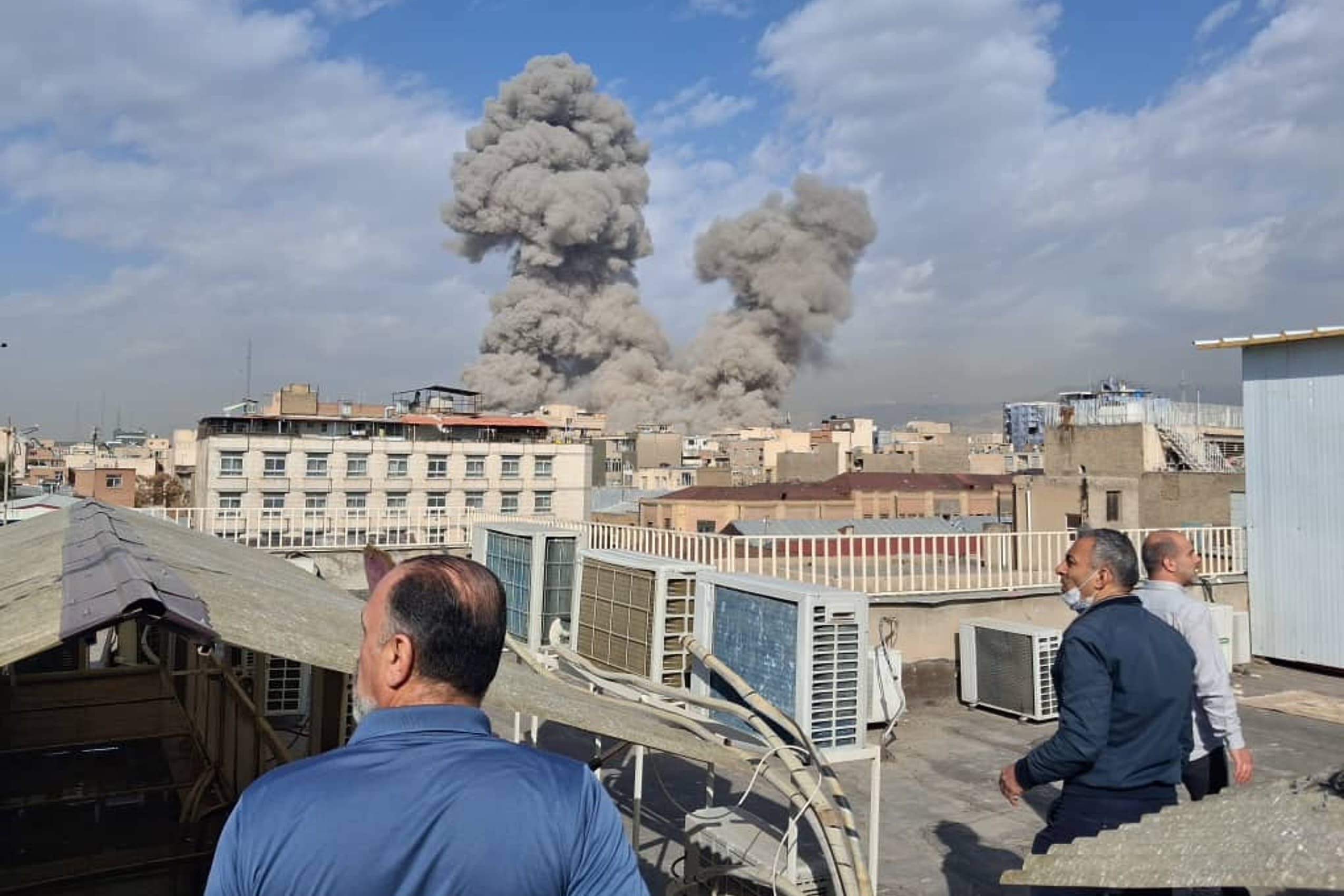
People run for cover following an explosion in Tehran
By Christian Edwards, Karina Tsui, CNN
(CNN) — The United States and Israel have launched a major attack on Iran, which President Donald Trump said would lay waste to the country’s military, obliterate its military program, and could even topple its regime.
In a video on Truth Social, Trump accused Iran of rejecting “every opportunity to renounce their nuclear ambitions,” and said the US “can’t take it anymore.”
Unlike the last time the US and Israel struck Iran, in June, these strikes began in daylight on Saturday morning – the first day of the week in Iran – as millions went to work or school. And whereas the US strikes in June were over within a few hours, sources have told CNN that the US military is this time planning for several days of attacks, suggesting broader objectives.
In response, the Iranian regime has launched an unprecedented wave of strikes across the Middle East, targeting several countries that host US military bases. Blasts have been heard from the beaches of Dubai to the streets of Doha, in what could be the opening salvos of a war that threatens to engulf the region.
The extent of the damage in Iran and across the region is still emerging. Here’s what we know so far.
How did we get here?
The Iranian government has been under severe pressure since the turn of the year. Already weakened by last summer’s war with Israel, which the US briefly joined, the regime has been battling a severe economic crisis which sparked nationwide protests in January.
After a crackdown left thousands of protesters dead, Trump promised to come to their aid. He warned the US was “locked and loaded” to attack and began moving huge amounts of materiel to the region.
Despite the military building, the US also resumed efforts to reach a new nuclear deal with Iran. The last round of talks ended in Switzerland on Thursday, with Iran agreeing “never” to stockpile enriched uranium. The Omani foreign minister, who has acted as a mediator in the talks, said there had been “significant” progress.
Why did the US strike Iran?
That progress, however, was not enough to prevent the US from taking military action. In his 2.30 a.m. address, Trump said the main objective of the operation – which the Department of Defense is calling “Operation Epic Fury” – is “to defend the American people by eliminating imminent threats from the Iranian regime.”
Those threats, he said, included Iran’s nuclear program – which the White House claimed to have “totally” obliterated with its strikes in June.
“It has always been the policy of the United States, in particular my administration, that this terrorist regime can never have a nuclear weapon,” Trump said, without providing evidence that Iran was any closer to obtaining a nuclear weapon. “They rejected every opportunity to renounce their nuclear ambitions, and we can’t take it anymore.”
The president also repeated his recent claims that Iran is building ballistic missiles which could reach the US mainland. In his State of the Union address Tuesday, Trump said Iran has “already developed missiles that can threaten Europe and our bases overseas, and they’re working to build missiles that will soon reach the United States of America.”
But these claims are not backed up by US intelligence, CNN has previously reported. An unclassified assessment from the Defense Intelligence Agency (DIA) from 2025 said that Iran could develop a “militarily-viable” intercontinental ballistic missile (ICBM) by 2035 “should Tehran decide to pursue the capability.”
According to two sources, the claim that Iran will soon have a missile capable of hitting the US is not backed up by intelligence. There is no intelligence to suggest that Iran is pursuing an ICBM program to hit the US at this time, the sources said.
Why is Israel striking Iran?
Prime Minister Benjamin Netanyahu has long viewed Iran as Israel’s most dangerous adversary. After crippling Iran’s proxies – Hamas in Gaza and Hezbollah in Lebanon – Israel last summer launched a war against Iran itself.
Although Israel halted the conflict after the US struck Iran’s nuclear sites, analysts had long suspected that Netanyahu would take an opportunity to resume attacks on Iran. With elections due in October, Netanyahu may also see the return to war as a chance to shore up his standing domestically.
In a video statement Saturday, explaining why Israel was resuming its strikes on Iran, Netanyahu also repeated his claim that the Islamic regime must not be allowed to acquire a nuclear weapon.
Are the US and Israel seeking regime change?
What was unusual about Trump’s and Netanyahu’s statements is that both were explicit about their hopes for regime change in Iran.
Trump addressed the Iranian people directly, telling them that “the hour of your freedom is at hand.”
“When we are finished, take over your government. It will be yours to take. This will be, probably, your only chance for generations,” he said.
Netanyahu also called on “all parts of the Iranian people” to “cast off the yoke of tyranny and bring about a free and peaceful Iran.” He said the US and Israeli actions “will create the conditions for the brave Iranian people to take their destiny into their own hands.”
An Israeli military official has, however, emphasized that the main focus of the operation remains on military targets.
What has been hit?
Explosions were heard in Tehran’s Pasteur district, where the highly secure compound housing the residence and office of Iran’s Supreme Leader Ayatollah Ali Khamenei is located, Iranian state-affiliated news outlets said. Several other cities were hit.
Two Israeli sources told CNN that the strikes targeted senior figures, including Khamenei, President Masoud Pezeshkian, and the armed forces’ chief of staff Abdolrahim Mousavi.
Iranian state media said top officials were safe, including Pezeshkian, but the targets suggest that Israel is seeking to decapitate the Iranian leadership.
How has Iran responded?
Iran has retaliated with an unprecedented wave of strikes across the Middle East, targeting several nearby countries that host US military bases, as well as Israel.
When the US and Israel last struck Iran in June, they targeted its stockpile of ballistic missiles, hampering its ability to retaliate. Iran could be trying to make use of its arsenal while it still has it.
Blasts have been reported in the United Arab Emirates, Qatar and Bahrain as well as in Iran’s key regional rival Saudi Arabia, which vowed to take “all necessary measures” to defend itself.
Iran’s foreign minister, Abbas Araghchi, condemned the US-Israeli strikes as unprovoked and illegal.
The-CNN-Wire
™ & © 2026 Cable News Network, Inc., a Warner Bros. Discovery Company. All rights reserved.
