Spanish leader slams ‘selfish’ EU response as death toll from Ceuta crossings climbs
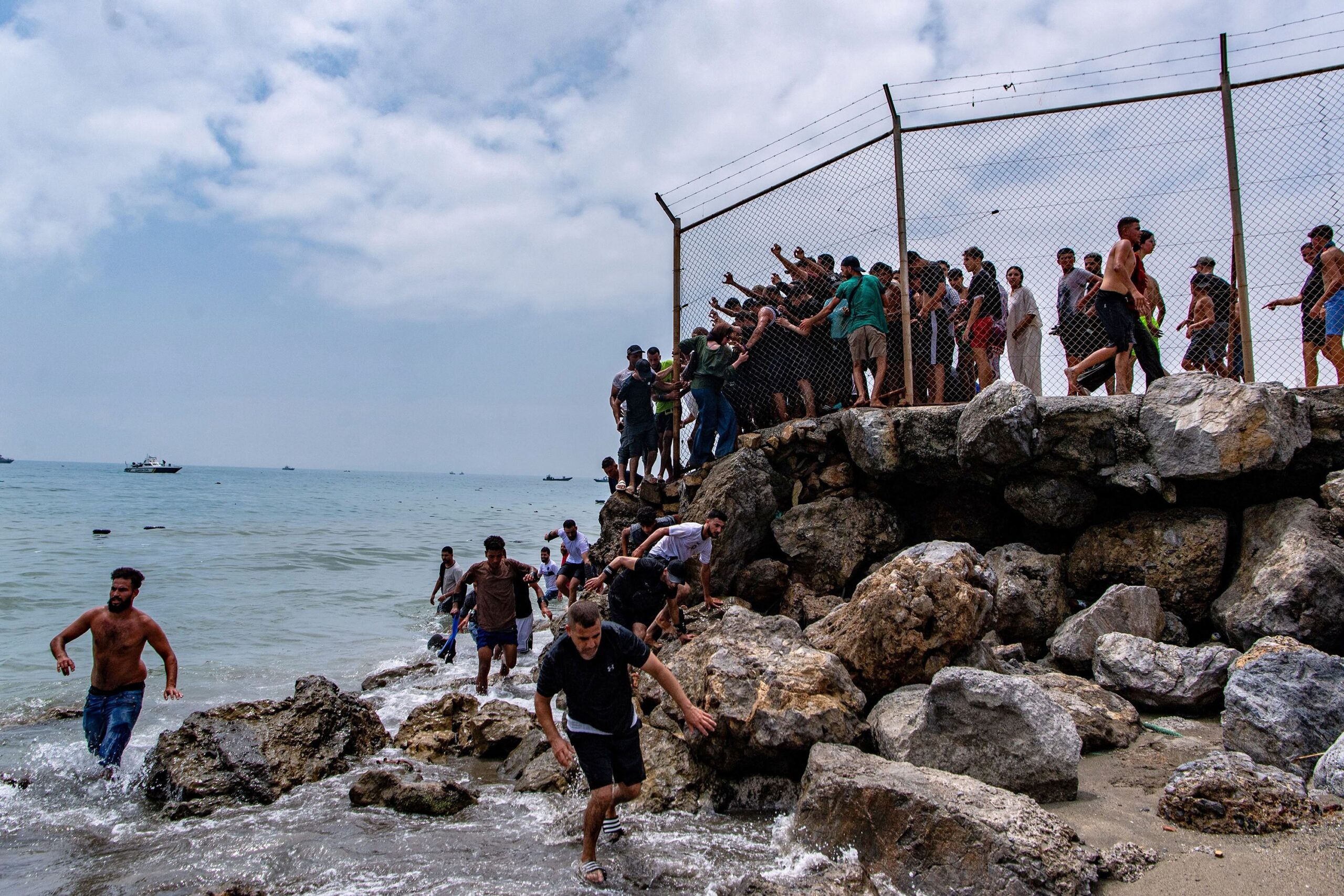
Migrants reach Spanish territory after swimming from Morocco to Ceuta

By Jack Guy, Vasco Cotovio, Jonny Hallam, CNN
(CNN) — Spain’s Prime Minister Pedro Sánchez has denounced the “selfish” response of several EU member states to an influx of migrants crossing into the Spanish exclave of Ceuta from Morocco this week, as the number of people who died rose to 67.
Most of those 50,000 to 60,000 people who attempted the crossing had returned to Morocco by Friday evening, Spanish authorities said.
Authorities in Ceuta said many of those who lost their lives drowned as crowds streamed over the border by land and sea on Thursday, overwhelming border guards.
In a letter quoted widely by European media, Sánchez condemned the “selfish, polarising and unlawful reaction” from other EU countries, after Italy temporarily placed some border controls on travel from Spain, while France’s Interior Minister Laurent Nunez ordered extra checks along the countries’ shared border. Italian Prime Minister Giorgia Meloni also called for Spain’s membership of the Schengen agreement to be suspended.
Sánchez said in his letter that “such an attitude” was “driven by prejudice, fake news, ignorance or political interest.” “In the current international context, the European Union cannot afford this kind of selfish, polarising and unlawful reaction,” he added.
Later on Saturday, Ireland, which holds the bloc’s rotating presidency, announced an emergency meeting among national ministers to discuss the crossings. The Irish Justice, Home Affairs and Migration Minister Jim O’Callaghan, posted on X that he remains “in close contact with all EU Member states” and is “continuing to monitor the situation.”
Spanish officials said they would try to expel those who entered irregularly as quickly as possible. The mass crossings come in the wake of a recent ruling by Spain’s Supreme Court that authorities cannot summarily deport migrants who arrive by sea without due process. However, experts say that legal decision was extremely narrow, with some arguing it was likely misinterpreted by migrants and traffickers.
By Friday, many appeared to have left of their own accord. Reuters reported seeing hundreds of people return to Morocco through border posts and holes in the fence, with some saying they could not find food or shelter in Ceuta.
On Saturday, Spanish officials began installing a floating barrier near the Tarajal breakwater, a key entry point into Ceuta, to “comply with” the Supreme Court ruling in July, the country’s Interior Ministry said in a statement.
Third-country nationals in Ceuta do not have free movement to mainland Spain or the rest of the Schengen area, and identity and visa checks are required for onward travel.
Sánchez previously said the mass crossings constituted a “violation of Spain’s territorial integrity” and blamed the influx on misinformation spread by people traffickers following the Supreme Court ruling.
Drivers of the surge
Reuters spoke to 16-year-old Moroccan Ayoub El Abyad, who said he and his cousin decided to make the 12-hour journey toward Ceuta after watching Instagram videos of other migrants crossing.
“Migration is about improving our lives. We agreed we would try the idea of crossing and trust in God,” El Abyad told the news agency from the Moroccan side of the border.
The videos circulated as reports and misinformation spread on social media about the Spanish Supreme Court ruling, leading many young Moroccans to see an opportunity to cross.
Broader economic frustrations are also a factor: Official figures cited by Reuters show that one in four Moroccans ages 15 to 24 are not in education, employment or training. Calm seas at this time of year also make swimming a more viable option.
Morocco does not recognize Spanish sovereignty over Ceuta or Melilla, describing the centuries-old Spanish exclaves as “occupied,” leading some analysts to question whether Moroccan authorities deliberately did little to prevent the crossings.
Concern across borders
The arrival of tens of thousands of people on Ceuta overwhelmed the small Spanish exclave with a population of just 84,000 people, and sparked a storm of criticism both at home and abroad.
Italy’s government said it was temporarily restoring some border controls on air and sea arrivals from Spain for 30 days.
Ordinarily, all travelers flying or sailing between Spain and Italy are not subject to routine border checks. However, Italian public broadcaster RAI reported that “targeted checks” on some arrivals would begin on August 1 and remain in place for a month. Citing Interior Ministry sources, RAI said the controls would apply only to non-EU nationals arriving from Spain in Italy, to verify their eligibility to enter.
Spanish and other EU citizens traveling to Italy, as well as anyone traveling from Italy to Spain, will therefore face no additional requirements, according to RAI.
Although Spain’s European territory is part of the Schengen Area, Ceuta and Melilla – Spain’s other exclave in North Africa – face additional border controls for goods and travelers between them and mainland Spain or Europe.
Migration is one of Europe’s most divisive issues. Far-right parties opposed to immigration have been on the rise, and governments across much of the continent have adopted tougher policies.
The pro-immigration policies of Sánchez’s Socialist government make it an outlier, and Thursday’s events will pile pressure on the prime minister.
The US State Department criticized Spain’s immigration policies and said the incident was a direct result of the Spanish government’s “deliberate efforts to enable and facilitate mass illegal migration into Europe.”
Meanwhile, US President Donald Trump warned that the migrant surge was an example of what’s to come if Republicans aren’t elected in November – something he said should be a “talking point for the midterms.”
The leader of Spain’s far-right opposition party Vox called the prime minister a “traitor” in a post on social media Thursday.
“He behaves like an enemy of the Spanish people,” Santiago Abascal wrote. “The national emergency can only be resolved by kicking him out.”
It’s not the first time this has happened in Ceuta – in May 2021, more than 8,000 migrants poured into Ceuta in just two days – although the scale of the influx this time appears to have been unprecedented.
“Honestly, I don’t even know why I came, and now I’m going back,” a young Moroccan man who said he was from Tangier told Reuters. “I haven’t eaten since lunch yesterday, even though I brought some money with me… What we’re doing is neither good nor enjoyable.”
CNN has contacted Spain’s Interior Ministry for comment.
The-CNN-Wire
™ & © 2026 Cable News Network, Inc., a Warner Bros. Discovery Company. All rights reserved.
CNN’s Sharon Braithwaite, Angelicachiara Yazbeck and Alessandra Freitas contributed to this report.
