Post-Assad Syria is facing its biggest stress test yet. Here’s why that matters
Protesters burn tires and other debris to block a highway during a demonstration over fuel price increases in Maarat al-Numan

By Tala Alrajjal, CNN
(CNN) — In eastern Syria, a man complaining about soaring fuel prices turns to the crowd recording him on their phones and addresses the country’s transitional president.
“We stood with you, so stand with us,” he shouts. “I swear by God, if things don’t change between now and the new year, the situation will turn into something we won’t want. Enough!”
Security officers stand by as he openly denounces the government.
What happens next is striking: nothing.
Earlier this month, thousands of Syrians poured into the streets in the broadest protests since Bashar al-Assad’s fall nearly two years ago. Unlike under his family’s 54-year police state – where public defiance could mean prison, torture, disappearance or death – they were allowed to go home.
The protests were widely broadcast on state media, in sharp contrast to Assad’s days, when state television peddled disinformation to discredit them, including claims that the protests were staged from faraway studios in Qatar.
Syria is now navigating the gap between newfound political freedom and an economic recovery that remains frustratingly distant for ordinary citizens, many of whom are losing patience.
The recent demonstrations were sparked by the government’s sudden decision to raise fuel prices by as much as 40%, which it blamed on the global energy crisis caused by the Iran war. As the outrage grew, the government walked back some increases and sent the energy minister before parliament in a show of accountability.
Analysts have praised the government’s responsiveness to its biggest economic stress test yet, but warned it will not change the fundamentals of the country’s cost-of-living crisis. The World Bank assesses that two-thirds of Syrians live below the lower middle-income poverty line, on less than $3.65 a day.
“We’re going to see these protests happening over and over again. It’s virtually impossible to overcome these severe economic challenges that Syrians are suffering. It will gradually become more challenging,” Ibrahim al-Assil, director of the Harvard Kennedy School’s Syria in Transition Lab, told CNN.
That economic strain is causing a growing disconnect between Syrians’ expectations of their new government and their reality.
“The honeymoon period was always going to come to an end. People’s expectations were going to rise, and their patience was going to wear thin if those expectations weren’t met. That’s basically where we are,” said Charles Lister, director of the Syria Initiative at the Middle East Institute in Washington, DC.
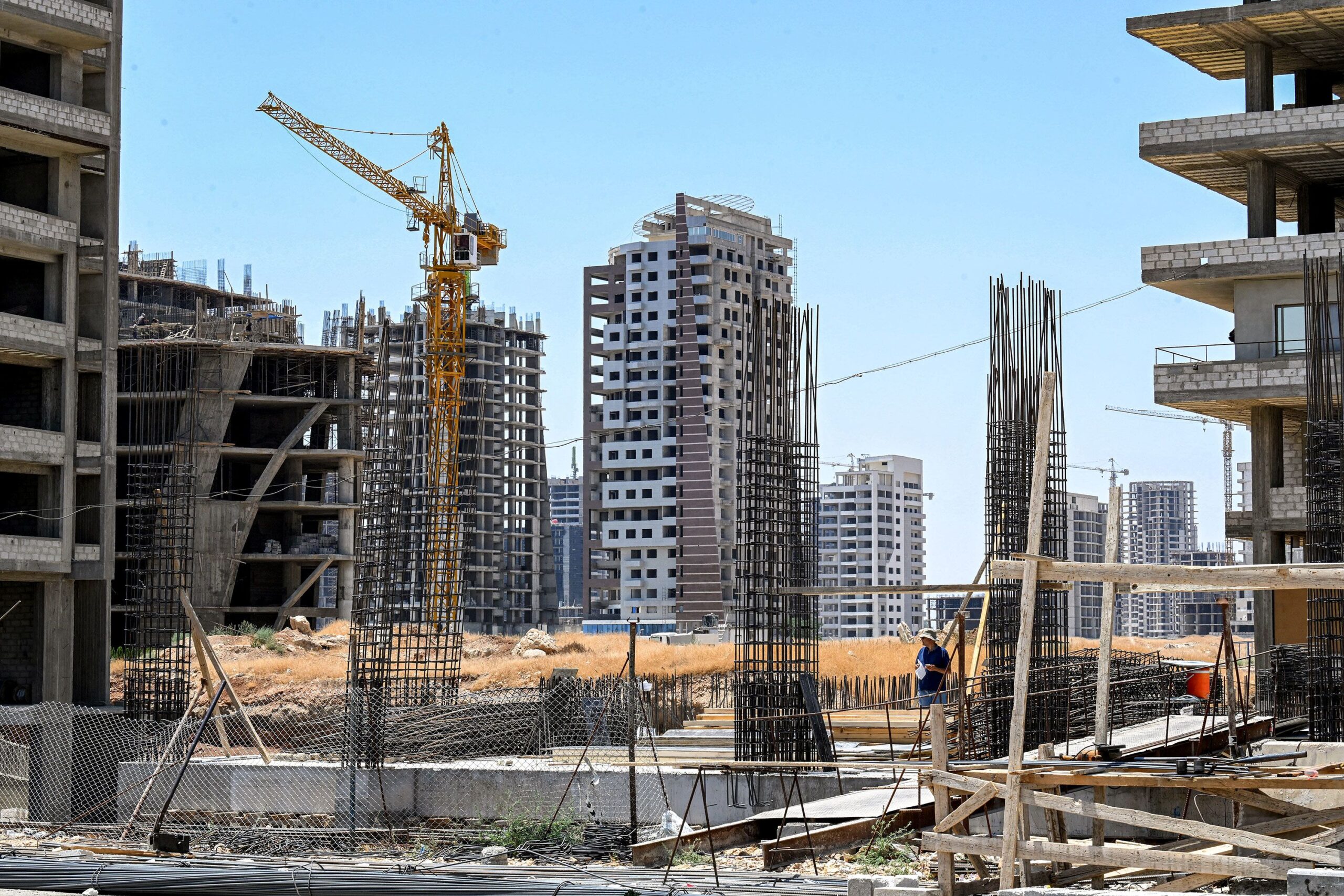
Interim President Ahmed al-Sharaa is racing to rebuild Syria – an estimated $216 billion task – before patience runs out. He inherited a nearly bankrupt state that was plundered by Assad and his cronies, leaving the new regime largely reliant on foreign investment.
His strategy has been to bring the country back onto the global stage after decades of isolation, and he is now trying to turn that international momentum into tangible economic gains.
“Syria has restored its status into the international community. It has been a transit for the world. We also built diplomatic bridges and we proved to the world that the security of the region has to start in Damascus,” al-Sharaa told the UN General Assembly on Wednesday.
The global embrace of al-Sharaa is perhaps best embodied by his warm rapport with US President Donald Trump, who he has met four times since last May. The outcome has been the complete lifting of all US sanctions on Syria, the key to unlocking foreign investment.
Turkey, Qatar, Saudi Arabia and the United Arab Emirates have driven most foreign investments thus far, estimated by Syria last year at $28 billion. The European Union has committed $2.7 billion in support, and French President Emmanuel Macron signed several new economic, transport and infrastructure agreements during a July visit to Damascus.
By one Syria expert’s count, the new government has met with representatives from about 100 countries since taking power. In a display of pragmatism, al-Sharaa even maintains ties with both Russian President Vladimir Putin, a top ally of the former regime, and Ukrainian President Volodymyr Zelensky.
Syria’s strategic geography
The breadth of that engagement reflects Syria’s strategic position. At a time of international discord, supporting Syria’s future has become a rare point of consensus – and the reason largely lies in geography. Syria sits at the heart of the Middle East, connecting Asia and Europe through its Mediterranean ports.
It reflects the belief that, just as the Syrian civil war reverberated far beyond its borders – sparking a migration crisis and enabling the rise of ISIS – a stable and prosperous Syria could bolster regional stability, encourage refugee returns and curb extremism.
Amid the Iran war, al-Sharaa has leveraged Syria’s strategic location to pitch it as a modern Silk Road, a trade hub that serves as a land bridge alternative to the straits of Hormuz and Bab al-Mandeb.
A proof of concept is already under way as thousands of tanker trucks loaded with oil from southern Iraq cross through Syria to the Mediterranean port of Baniyas.
But for ordinary Syrians, the government’s ambitious plans have yet to show tangible results.
Lister says the international community sees a real opportunity in rebuilding Syria’s future, but it will take time.
“The reality is that most of these projects are 10-year strategic projects. They’re not going to reduce the price of bread, or immediately bring in more fuel or reduce the cost of fuel in Syria,” he said.
Lister says the end of American sanctions has brought in a flurry of new small and medium-sized investment projects that will put people to work more quickly.
“It’s those kinds of projects that offer a far greater chance of starting to put the seeds in the ground that lead to an amelioration of the challenges ordinary Syrians face,” he said. “But it’s not going to result in those things being fixed next week. It’s probably going to take another year or two.”
‘Revolutionary’ political capital running out
Karam Shaar, a Syrian political economist who runs an advisory firm, estimates that just 5% of the promised deals have made tangible progress. Among the most visible are the renovations of power infrastructure and the Damascus airport by UCC Holding, led by the influential Syrian-Qatari Al-Khayyat brothers.
“The economy is undoubtedly recovering. But that’s never the question for the average person. What matters to them is whether their livelihoods are improving,” he told CNN.
A Syrian protester, Bassam Al-Ali, complained to Reuters that the government was focused on big-dollar deals rather than cost-of-living improvements.
“We do not want roundabouts. Every day they build a new roundabout that costs a million thousand dollars and malls and I don’t know what. Let your people live,” he said, addressing al-Sharaa. “Your people were with you, are still with you now and will remain with you but this will let things explode.”
Al-Assil warned that as economic grievances build, the “revolutionary legitimacy” al-Sharaa’s government has accrued could fade away.
“Buying patience from people requires allowing them to participate, making them feel that their voices are heard.”
The Israel factor
But even if the government can close the gap between international investment and everyday economic improvement, it faces another obstacle largely outside its control, one that al-Sharaa directly called out at the UN on Wednesday.
“The world is joyed about our return. But Israel is launching attacks against Syria,” he said. “This is at odds with the orientation we’re seeing at the global level.”
He estimated Israel has carried out nearly 500 strikes in Syria since he took power. Israel also occupies large parts of southern Syria and Israeli officials have said the military plans to stay there indefinitely.
Israel claims it does not trust al-Sharaa and needs a security buffer to prevent terrorism attacks on its soil. War-weary Syria maintains it does not want a conflict with its neighbor.
The two sides have been in direct talks since August of last year.
Al-Sharaa said Tuesday at an Atlantic Council panel in New York that negotiations “reached 90% of agreements” until Israel withdrew for “different reasons.”
Lister says the instability brought on by Israel’s actions is a top concern among investors who ask him about opportunities in Syria.
“If the Israelis continue their current posture after their elections (in October), then more and more external investment into Syria is less likely – because they are waving this massive hammer over the head of Damascus,” he said.
“This particular issue is just as central to the questions around economic recovery as sanctions, as investment prospects, as small and medium-sized enterprises. Israel is just as important.”
The-CNN-Wire
™ & © 2026 Cable News Network, Inc., a Warner Bros. Discovery Company. All rights reserved.
