Saudi-led coalition pledges support for Yemeni offensive against Iran-backed Houthis
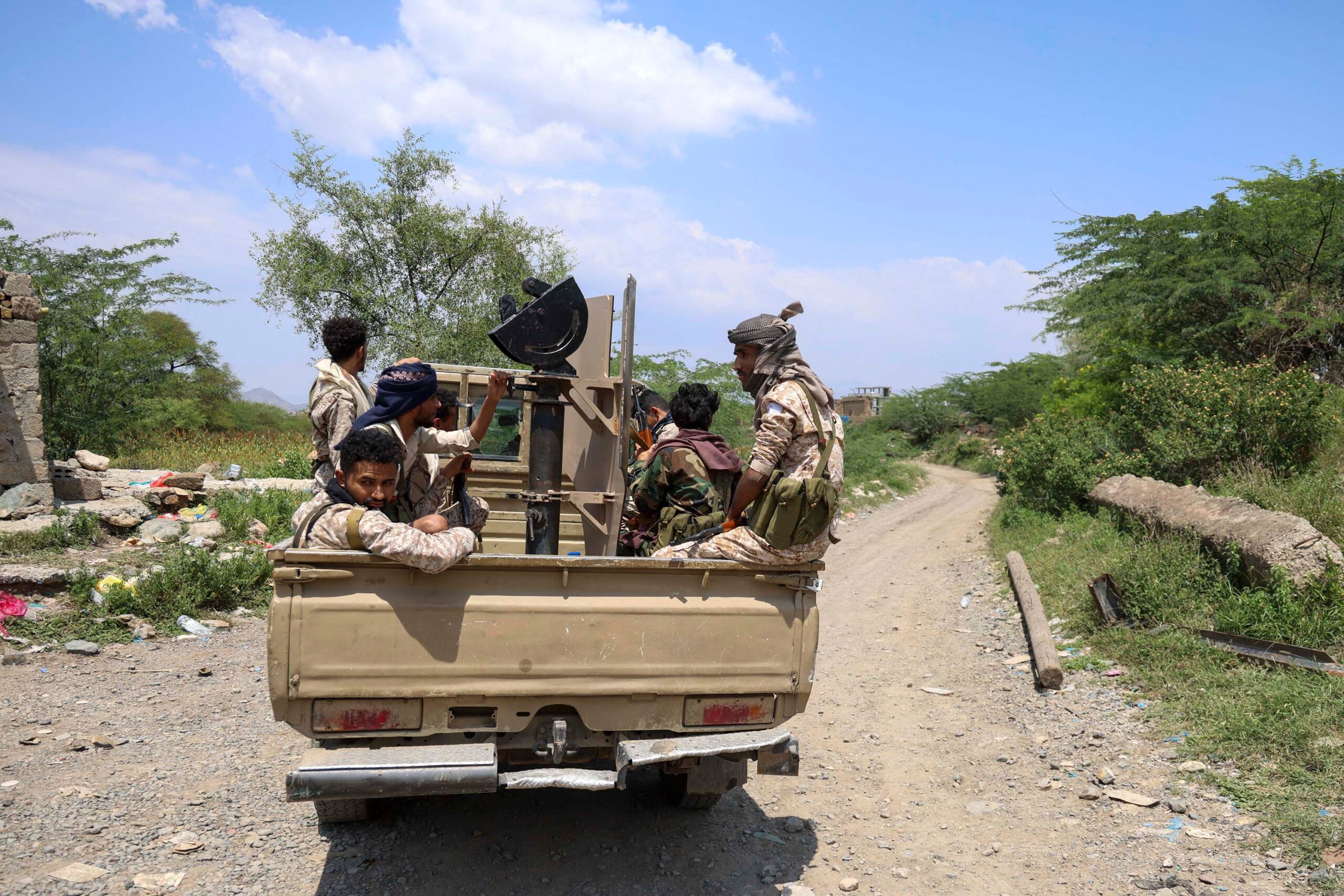
Saudi-backed Yemen government soldiers ride in a pick-up truck near the Jabal Han front

By Tim Lister, Ibrahim Dahman, Mohammed Tawfeeq, and Ibrahim Dahman, CNN
(CNN) — The Saudi-led “Coalition to Support Legitimacy in Yemen” pledged full support on Sunday as Yemen’s internationally recognized government announced the start of a major military offensive aimed at rolling back recent gains by the Iran-backed Houthi movement.
Last month, the Iran-backed Houthis carried out a lightning offensive down the Red Sea coast, successfully seizing control of a key port and further putting pressure on the safety of international shipping.
Rashad al-Alimi, head of Yemen’s presidential council, said in a televised speech on Sunday that the military operations aimed to reclaim the remaining territory held by Houthis and restore state authority across the country.
An offensive had been widely expected amid dozens of Saudi airstrikes against Houthi positions and further Houthi gains in southern Yemen.
The renewed fighting has already forced tens of thousands of people from their homes, and what happens next could shift the balance of power in Yemen and further exacerbate an already bleak humanitarian crisis. Three out of every four families in parts of Yemen are going hungry because of the surge in fighting, the World Food Program said last week.
Al-Alimi said the decision to launch operations followed “the Houthi militias’ continued mobilization, escalation and attacks, as well as their threats against civilians, facilities, neighboring countries, and international shipping lanes.”
In a separate statement, military spokesperson Majid Al-Nuzaili said government forces had begun a “battle for liberation” aimed at ending Houthi control over remaining territory and restoring state institutions.
Al-Nuzaili also called on fighters aligned with the Houthis to lay down their arms and return to their homes, saying the government remained committed to protecting civilians during the offensive.
The Saudi-led coalition spokesperson Turki al-Maliki said they will continue providing “full operational support” to Yemeni government forces in what he described as efforts to restore state institutions and end “the Houthi coup.”
Al-Maliki also accused the Houthis of continuing attacks against Saudi Arabia and international shipping in the Red Sea and Bab al-Mandeb Strait.
“Such threats undermine regional and international security, jeopardize freedom of navigation and international trade, the lifeblood of the global economy,” he added.
Yemen’s Houthi-controlled armed forces said on Sunday that Saudi Arabia had carried out 106 air and missile strikes over the previous 24 hours targeting the capital Sanaa and other areas of the country.
The Houthi statement did not provide details on casualties or damage resulting from the reported attacks.
In retaliation for airstrikes against Sanaa and other locations, the Houthis claimed Sunday that they had struck vital Saudi energy facilities.
“The first targeted Aramco company in the Saudi capital, Riyadh, and the second targeted Aramco company in the Khurais area,” causing large fires at the targeted sites, a Houthi military statement said.
There has been no word from the Saudis on the claimed strikes.
Early in September, the Houthis took a swath of Yemen’s Red Sea coast as far south as the critical Bab al Mandeb waterway, a chokepoint for commercial shipping crossing into the Indian Ocean.
They announced that Saudi shipping trying to use the strait would be targeted, threatening additional pressure on global trade and energy routes.
The Houthis have fired ballistic missiles and drones at multiple targets in Saudi Arabia since late July, including industrial and energy infrastructure.
Much of the recent fighting has been in the southern region of Taiz, as the Houthis have sought to cut off government forces in the regional capital. The Houthis claimed on Sunday to have taken a critical highway linking Taiz with the seat of the Yemeni government in Aden.
Taiz is the third largest city in Yemen, with a population of several hundred thousands. It is also home to thousands of government troops.
Further east, in the al-Jawf region, the Houthis on Sunday claimed to have inflicted heavy casualties on government forces with a barrage of missiles and drones as they redeployed for the new offensive.
Yemeni government forces, backed by Saudi airstrikes and a blockade of Houthi areas, started fighting the Houthis more than a decade ago.
On Monday, officials from Saudi Arabia will convene with Turkish and Pakistani officials in Riyadh to discuss regional developments.
The meeting is part of the Strategic and Political Defense Committee, a NATO-style defense pact established in August, which is committed to organizing security and military cooperation in the region. The Saudi foreign ministry has said that it “does not represent an effort to establish a military axis or a sectarian bloc.”
The war in Yemen, which began in March 2015, had killed 377,000 people by the end of 2021, including those killed by direct and indirect causes, according to the United Nations. Over 150,000 of these deaths were the direct result of the armed conflict, it said, while more have died as a result of hunger and disease due to the humanitarian crisis caused by the war.
A 2022 UN-brokered truce brought a period of relatively low levels of hostilities between the two sides until violence surged again in August.
This story has been updated.
The-CNN-Wire
™ & © 2026 Cable News Network, Inc., a Warner Bros. Discovery Company. All rights reserved.
