Is cursive worth teaching? Two different perspectives from St. Joseph
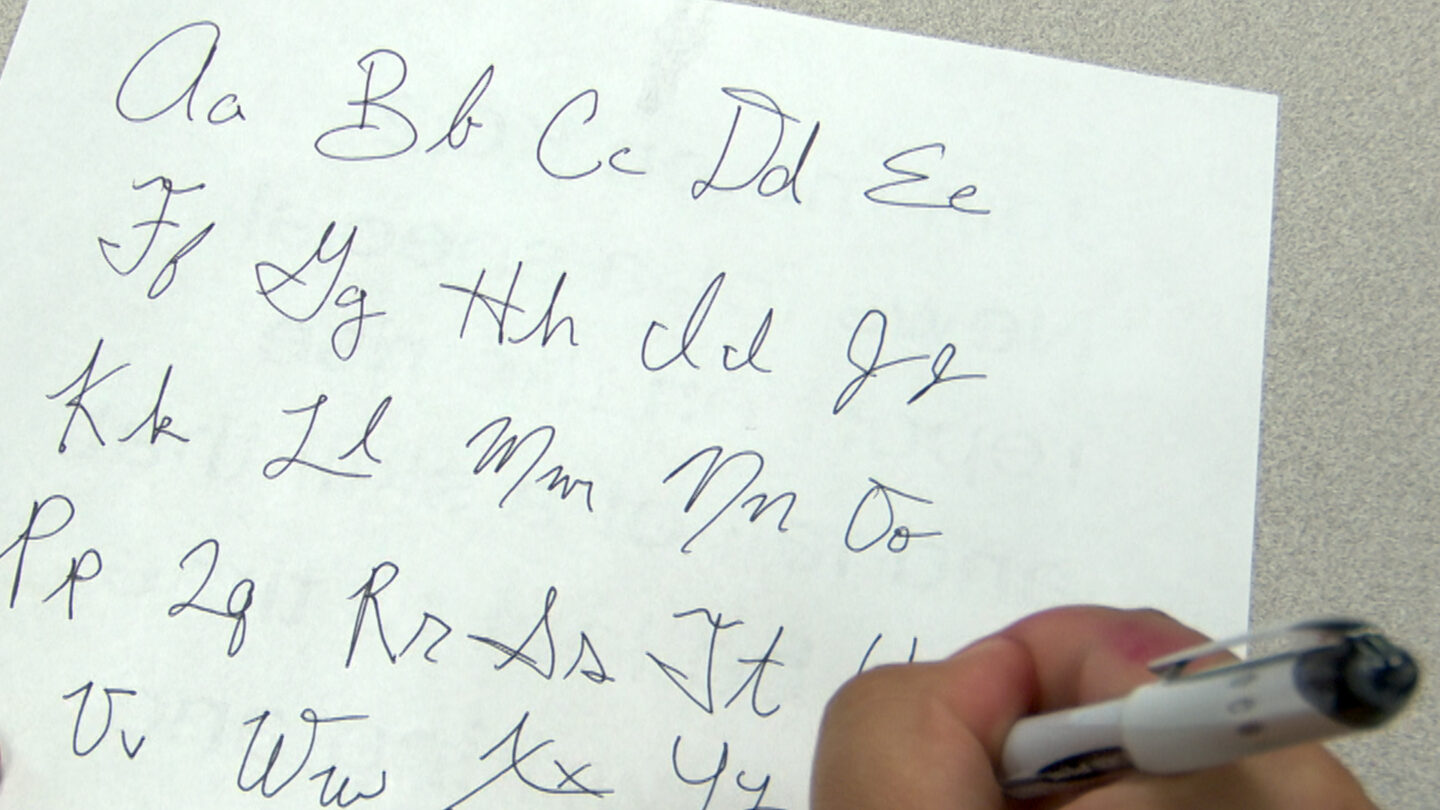

ST. JOSEPH, Mo. (KQTV) -- In an era of keyboards, touchscreens and autocorrect, cursive writing occupies an uncertain place in American education.
In the St. Joseph School District, it's still taught, but not tested, tracked or required as a standalone skill.
Heather Wiedmer, an instructional coach with 25 years of teaching experience in the district, said cursive is embedded within Missouri's Learning Standards under a broader language standard: "Students will write legibly with print and cursive."
"It's not a standalone standard," Wiedmer said. "But we do teach it here in the Saint Joseph School District. Instruction begins in second grade."
Teachers use Benchmark Advance, a district-approved curriculum resource which includes a scripted approach to teaching cursive strokes.
Instruction continues through third grade and up, but the district does not assess whether students actually master it.
"There is no assessment," Wiedmer said. "We're not going to say at the end of second grade, 'Can your student write these letters in the cursive format?' It's instructed, but we don't assess and track that."
"Whether students retain cursive comes down to the individual child," Wiedmer said.
Some find the flow of cursive smoother than print, others revert to print as their primary method of writing.
"Some kids find that the flow of cursive is actually the path of least resistance for them," she said. "And then for some students, their fluent path kind of reverts back to print."
Wiedmer said handwriting remains important in early grades.
She cited research showing that physically forming letters strengthens reading connections in the brain, and said the district emphasizes paper-and-pencil work in lower grades before keyboarding takes precedence later on.
Olivia Stewart, an education reform advocate who does not have children of her own, said she believes cursive has value, but limited.
"I think cursive is a valuable tool," Stewart said. "It is a pretty way to write. But really, I feel like that's kind of where the value stops, past being able to read cursive writing, letters, documents."
Stewart pointed to a larger concern: literacy rates.
She cited the statistic that one in five American adults is functionally illiterate or has low literacy skills, and argued classroom time spent on cursive could be better used elsewhere.
"Focusing on things like cursive in classrooms is taking so much attention away from where those kids actually end up and how literate they are by the time they graduate," she said.
Stewart said cursive can be a supplementary skill, or a lesson taught at home.
"I think if there isn't room to teach it in the classroom, it's the perfect thing for a parent to teach," she said.
She also pushed back on the idea that cursive is necessary for reading historical documents like the Constitution, noting that such documents have been transcribed many times.
Stewart questioned whether cursive signatures need to be taught at all, pointing out that many professionals don't use legible letters in their signatures, and that other cultures use different formats.
Stewart said she believes cursive is a dying art, and that it will naturally phase out if not emphasized.
"I think it could honestly be at risk of naturally phasing out," she said. "And I just don't think that's the worst thing that could happen."
Wiedmer disagreed with the characterization.
"I don't think it's a dying art," Wiedmer said. "At least in the state of Missouri, it's still embedded in the standards. Even though it's not a standalone, it's still embedded. Here in St. Joe, we still teach it."
Wiedmer said she personally finds cursive valuable, both for reading historical documents and for sentimental reasons.
"From a sentimental standpoint, it's important to me," she said.
Missouri is not among the states that require cursive instruction by law.
The decision is left to individual districts, which means practice varies widely across the state.
Neighboring Arkansas requires cursive by law; Missouri has seen bills introduced to mandate it, but none have passed.
Regardless, Wiedmer said she is proud of the district's teachers and the work they do.
"I'm proud of our teachers for the hard work that they do and student achievement that happens here every day in the Saint Joseph School District," she said.
Stewart, meanwhile, said she would love to see a system where cursive could be taught without taking away from other priorities, but doesn't believe schools are there right now.
"I would love to have the impression of our education system that we could afford to teach it," she said. "I just think that we're not there."
