How AI and personality evaluations helped fuel Brad Underwood’s evolution and send Illinois to the Final Four
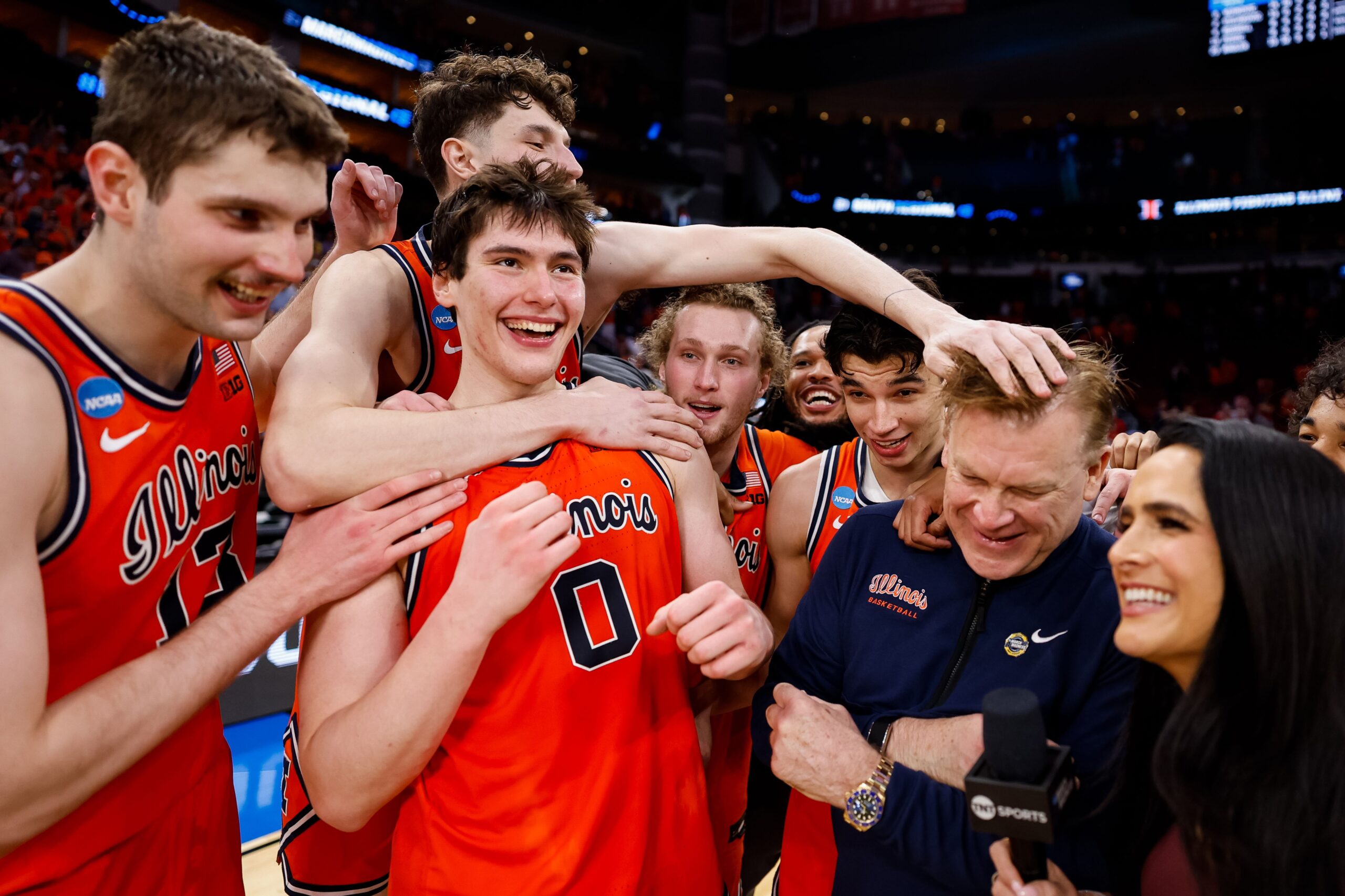
Illinois head coach Brad Underwood celebrates with his team after the Illini's Sweet 16 win against Houston last week.

By Dana O’Neil, CNN
(CNN) — Marcus Domask was not good enough and no one could convince Brad Underwood otherwise.
As he watched the Southern Illinois would-be transfer on film, Underwood repeatedly told his staff no, as a power forward, Domask was simply not a Big Ten player.
Until, that is, one of his assistants handed Underwood a different evaluation, one that did not say a word about Domask’s skillset, upside or basketball potential but stressed his compatibility as a teammate, his willingness to learn, his competitive spirit and work ethic.
“I read that and said, ‘We need to go get him tonight,’” Underwood told CNN Sports.
In his single season with Illinois, Domask started 38 games, finished second on the team in scoring (15.9), first in assists (3.9) and fourth in rebounding (5.0), helped the Illini to the Elite Eight and was named Big Ten Newcomer of the Year. So crafty was Domask’s shooting touch, Underwood took to calling him Luka – as in Dončić.
“And I would not have taken him, without that evaluation,” Underwood says.
It would be a bit of an overstatement to say that Profile, the assessment tool Illinois uses, is why the team is in the Final Four for the first time since 2005. But it’s not unfair, however, to say that the new tool played a big part in how Underwood brought the Illini back.
“These teams are like a Fortune 500 company,” Underwood said. “And like any good CEO, you need to know your people – what interests them, how they succeed. If you don’t know that, how can it work?”
Fitting the Profile
Nearly 20 years ago, Chad Brown, a frustrated former football coach and a curious information seeker, started Profile. In layman’s terms, it is a personality test, but his is a tweaked version of the more common assessments, such as DiSC.
It’s designed specifically to work with athletes, relying on his experience as an athlete and a coach to home in on the values that translate best to sports. Professional and college teams – Purdue’s Matt Painter was an early convert, as were the Dallas Cowboys – have been using it for years.
During the Covid-19 break, Brown networked with a number of people in athletics – “a lot of bored agents,” he told CNN Sports with a laugh – including Underwood’s agent, Brett Just. By then, the Illini were in the midst of a three-year NCAA tournament hiatus as Underwood attempted to resuscitate the program. Before the pandemic shuttered the season, the Illini were in a slump, if not an entire freefall, a 16-5 start slipping to a 5-5 end.
He reached the NCAA tournament the next two seasons, but in 2021, No. 1 seeded Illinois lost to Loyola-Chicago in the second round, and to Houston as a four-seed a year later. Underwood wanted to remake his team – with more size and shooting – but Just thought Profile might give his client a little extra edge.
“It took me a while to get in,” Brown admits. “(Underwood) was initially very guarded.”
Or maybe more accurately, more old school. Underwood is a coaching lifer, the kind that started barely in view of the bottom rung of the ladder. Forty years ago, he got his first job as a graduate assistant at Division III Hardin-Simmons in Abilene, Texas. Married for eight days, he and his bride Susan moved into a $300 a month apartment on his $299 a month salary; the space was so small they had to relocate the microwave near the front door.
But he loved the grind so much that when he was offered a head-coaching job at Dodge City Community College, he accepted it even though the school technically couldn’t pay him; Underwood’s $12,500 salary came via his role as on-campus audio-visual coordinator.
He counts Bob Huggins and Frank Martin, who he worked with as an assistant at Kansas State, as his mentors and closest friends, and invariably came to mimic their tendencies and share their values. Hard work, discipline, toughness – that was the route to success.
Yet he, like Huggins and Martin, is something of a personality chameleon, men whose fiery on-court demeanors mask who they really are. Huggins is a quiet talker with a dry wit and Martin can be a downright big-hearted pile of goo.
To his surprise, Brown found a similar dichotomy when he applied his assessment to Underwood.
“You think he’s a bulldog, but in our values section, his number one is friendship,” Brown said. “He’s very emotionally intelligent and relationships for him are front and center.”
In a big, beautiful twist of irony in other words, Underwood’s actual personality made using personality assessments more appealing.
A convert was born.
“In the NBA, teams come in and evaluate and spend two, three days talking to a kid’s dorm director, his apartment manager, whoever,” Underwood says. “They’re investing in people, so they want to know what they’re getting. I want to find know what I’m getting in my locker room.”
The evolution of an old-fashioned coach
The Illini’s rotation is made up of one sensational freshman (Keaton Wagler), two Croatian players (twin brothers Tomislav and Zvonimir Ivišić), a Montenegran (David Mirković), a Greek-born, Cali-raised son of a Serbian NBA veteran (Andrej Stojaković) and five transfers (Zvonimir Ivišić, who came from Arkansas; Stojaković who arrived via Cal; Ben Humrichous, last seen at Evansville; Jake Davis, a Mercer transplant; and Kylan Boswell, most recently at Arizona).
This is why Brown’s business is booming everywhere, but especially in Champaign. Underwood has greeted the changes in college athletics like a child running to the doors on the last day of school. He has dipped heavily into the transfer portal and used the appeal of NIL, plus the overseas knowledge of his two assistants – Orlando Antigua and Geoff Alexander – to lure European players stateside who otherwise might make more at home.
The combination is not only a melting pot of a roster, but a change in recruiting philosophy. After 40-plus years in the business, Underwood can evaluate a player’s shooting stroke. He can get a feel for his basketball IQ and understand how his size translates to Big Ten basketball.
But the relationship-building Underwood no longer can afford to spend as much time building relationships.
And since every decision comes with a price tag, he also can’t afford to make mistakes.
Brown’s assessments helped Underwood first identify the kinds of players he prefers. Along with the obvious – good teammates, good workers – Underwood values trust.
“He wants a guy who says when he walks in the door, ‘What do you need me to do, Coach?’” Brown says. “Low trust isn’t a dealbreaker for him, but it’s a question of how long he’s willing to wait to earn it. He’s not interested in someone who’s just a hired gun.”
But as he’s grown in his comfort with the assessment tools, Underwood has learned he has to bend, too. He cannot have a bunch of mini mes, and now welcomes people on both his staff and his roster who are both more independent thinkers. He’s also learned that his can’t be the only personality that matters.
It was, admittedly, a tough shift.
“I was way more rigid,” he says. “I didn’t care if people wanted to know why. Why was because that’s how we did things. I mean, I’m a why guy so I have to understand my players need that information, too.”
Using AI to win on the court
Ask Profile AI: Which role suits this athlete best right now: star, specialist, glue player, spark, or stabilizer?
Ask Profile AI: What pre-game routine best stabilizes this athlete’s focus and emotional state?
As the sports world has shifted, Brown has amped his own assessment techniques. He’s not only expanded the information he can provide, but he’s also recently introduced an AI feature, which allows coaches to ask the assessment tool for immediate feedback.
Explaining AI to coaches, he admits, has not gone over very well.
“You say, ‘You know like ChatGPT?’ and some of them have no idea what you’re talking about,” Brown said. “We’re like, ‘You know the stuff that’s going to run you over if you don’t catch up?’”
And yet here is the 62-year-old Underwood: “The AI stuff is really helpful,” he says, a sentence so diabolically disarming coming out of a 60-something’s mouth, even he laughs when he says it.
“You know what, though? I’ve had a blast with it. I really like my team. I really, really like my team,” he adds.
A team, it is worth remembering, that will play in the Final Four on Saturday.
The-CNN-Wire
™ & © 2026 Cable News Network, Inc., a Warner Bros. Discovery Company. All rights reserved.
