Scientists name ancient crocodile species found in rock that built the Great Sphinx
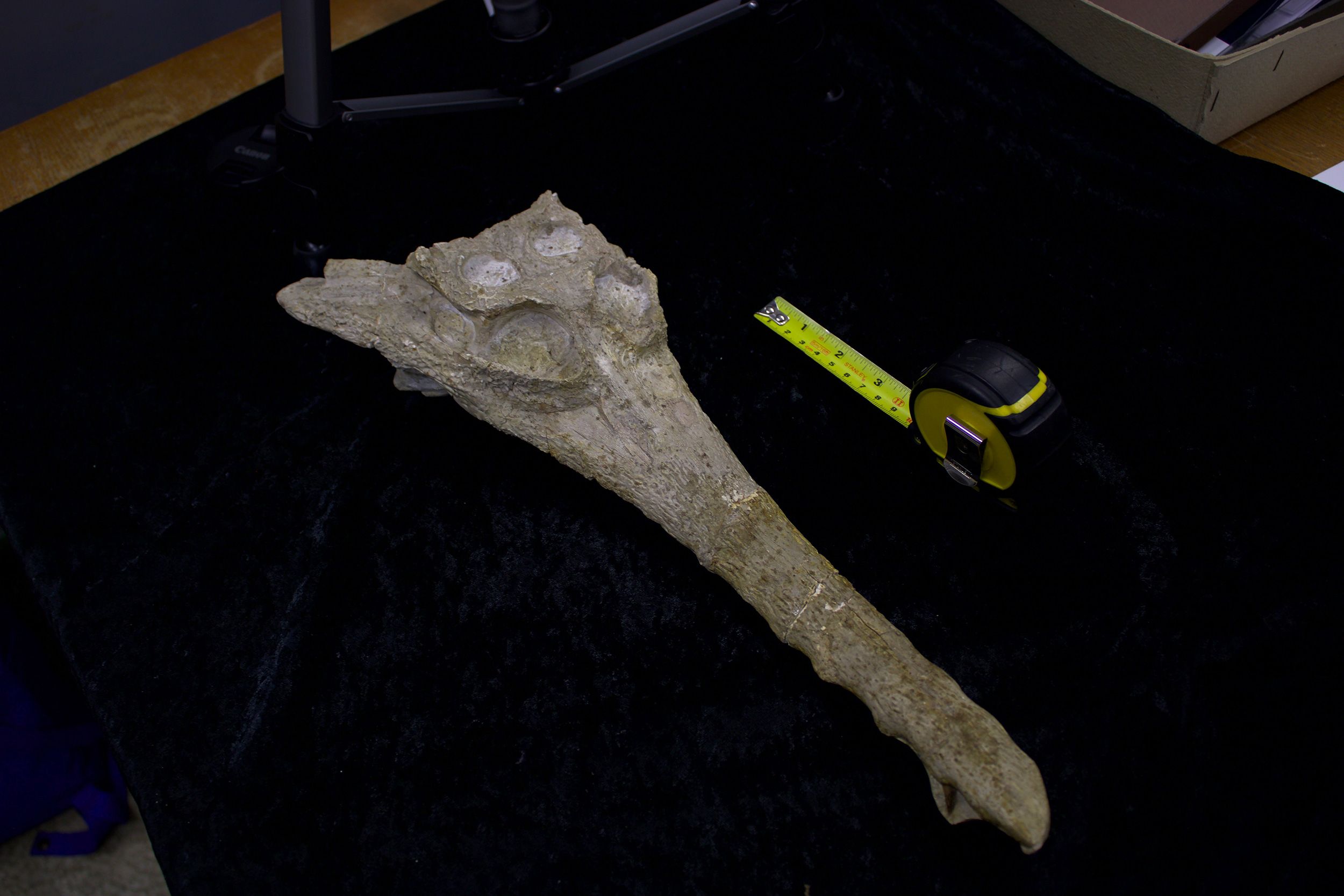
A top view of the Herugavialis skull. Paleontologists newly identified a crocodilian species that once roamed a shallow sea in what’s now Egypt about 45 million years ago.

By Taylor Nicioli, CNN
(CNN) — The croc family tree may be getting a new branch. Analyzing fossilized remains discovered in the same bedrock that built the Great Sphinx, paleontologists newly identified a crocodilian species that once roamed a shallow sea in what’s now Egypt about 45 million years ago.
The Mokattam Formation in northern Egypt is a thick layer of limestone that has preserved prehistoric marine fossils, including fish, sharks and early whales. That same limestone outcrop also provided much of the raw material ancient Egyptians used to build some of their most famous monuments, including the Great Sphinx and the pyramids at Giza.
Now, scientists have identified the extinct crocodile species that lived millions of years before the Egyptians built the structures. Not only do the crocodile specimens share the same geologic foundation as the iconic landmarks, but one of the key fossils, a nearly complete skull, bears a striking resemblance to the Sphinx: The skull, first unearthed in the 1920s, is missing the tip of its snout similar to the Sphinx statue, which famously lost its nose. This coincidental trait inspired researchers to name the new genus Herugavialis after Heru, or Horus, the Egyptian god associated with the construction of the mythical creature.
The species discovery adds to scientists’ understanding of the diversity and history of gharials, a group of crocodilians with a complicated evolutionary history, according to the authors of a study published Tuesday in the journal Royal Society Open Science.
“Herugavialis cairensis is one of the six species of gharials that we see in the Mediterranean across a 43 million year period, from 66-23 million years ago. Of course, there could be even more species that we just don’t know about yet,” said co-lead study author Paul Burke, a vertebrate paleontologist and postdoctoral researcher at the Swedish Museum of Natural History in Stockholm.
Only two gharial species exist today — found in the Indian subcontinent and Southeast Asia — but the lineage’s fossil record spans the globe, with specimens uncovered in places including the United Kingdom, Sweden, Italy, Egypt and Japan, Burke said in an email.
A glimpse of prehistoric Egypt
Gharials, or gavials, are characterized by their long, slender snouts. The two living species include the critically endangered Indian gharial, Gavialis gangeticus, and the endangered false gharial, Tomistoma schlegelii. The false gharial gets its moniker from its resemblance to the Indian gharial, despite being a different species.
The fossils analyzed in the new study, including the skull and five other specimens, were initially classified in 1927 as the previously named extinct species Tomistoma cairense based on their resemblance to the living false gharial. However, after performing evolutionary analyses to assess the relationships of extinct and living crocodilians, and computed tomography or CT scanning to peer inside the skull, the study authors found that the remains did not belong to the genus Tomistoma.
“It was already known and recognised as something distinct, but more detailed work was needed to resolve exactly what it represented,” said co-lead study author Philip Mannion, a professor of paleobiology at the University College London.
Instead, the crocodilian’s features represent a new genus, Herugavialis. Burke, who was reconstructing fossil gharials for his doctoral project, noted the subtle differences between the unidentified species and the false gharial, and started to work on an up-to-date description in December 2023.
Herugavialis had razor-sharp, pointed teeth “which, alongside their long, thin snout would have been adapted to capture fish,” Burke said in an email. “The Mokattam Formation, where Herugavialis was recovered from, preserves several species of bony and cartilaginous fish fossils, which Herugavialis likely fed on.”
The semiaquatic predator’s eyes would have also protruded from the skull, similar to the Indian gharial, because the eye sockets were raised like a telescope, Burke added.
The Herugavialis skull may have not been discovered within the Great Sphinx itself, but the statue and the pyramids are known to be troves for both ancient Egyptian and prehistoric finds. Scientists have previously discovered hundreds of thousands of smaller fossilized organisms, such as bivalves and foraminifera — tiny creatures that lived in Egypt’s past marine ecosystem — embedded within the grand monuments.
“It’s probable that larger fossils are also present within the walls of these monuments and I think it’s very likely that other fossils will continue to be found in this formation, especially of animals that like shallow marine environments,” Mannion said in an email, adding that prehistoric turtles could be a potential example.
The vast fossil collection unearthed from the Mokkattam Formation reveal the rich ecosystem and the wide diversity of species that once lived in prehistoric Egypt, he said. Identifying Herugavialis from a nearly centuries-old fossil find also highlights the importance of reevaluating museum collections.
“There are other fossils in similar situations, but often this is just about time and resources, both for researchers and curators, rather than that no-one is aware of their existence,” Mannion said.
Reclassifying the crocodile species “helps paint a better picture of what large predators were like in the region,” said Alex Hastings, the Fitzpatrick Chair of Paleontology at the Science Museum of Minnesota in Saint Paul, who was not involved with the study.
“This expands the known variety of forms of these amazing long-snouted crocodylians across the Mediterranean in ancient times and gives us better understanding for how that would have influenced ecosystems during the greenhouse environment of the Eocene,” Hastings said in an email, referring to the period from about 56 million to 34 million years ago when global temperatures were much warmer than today.
Herugavialis, like many other species, had initially been assigned to a living genus even though the croc was alive a long time ago, he noted. “Studies like this provide crucial data that allows us to realize the real diversity and evolutionary background of these creatures rather than lumping them into living systems.”
The-CNN-Wire
™ & © 2026 Cable News Network, Inc., a Warner Bros. Discovery Company. All rights reserved.
