Protests and violence now go hand in hand in France. It wasn’t always like this
Protesters inside a bar face riot mobile gendarmes near Porte de Vincennes during a demonstration in Paris

By Saskya Vandoorne, CNN
(CNN) — Lucas Petit was just 11 when hundreds of thousands of men and women wearing yellow vests poured onto the streets and occupied roundabouts across France in November 2018.
His memories are hazy, though stories of clashes with police left a lasting impression. If he ever joined a demonstration, he knew what to expect.
“It helped shape this whole collective image of a violent protest,” he told CNN.
Petit, now 19, belongs to a generation for whom tear gas, water cannons, rubber bullets and stun grenades are par for the course when protesting.
“We feel somewhat compelled to respond with violence because we’re facing social, institutional, symbolic and now physical oppression,” Petit said. “So I think violence has become normalized.”
Petit has been blockading his school in eastern Paris for more than a month. He’s part of a movement that started out demanding better conditions at French schools and has since swelled into a collective cry of anger, bringing together groups with different grievances.
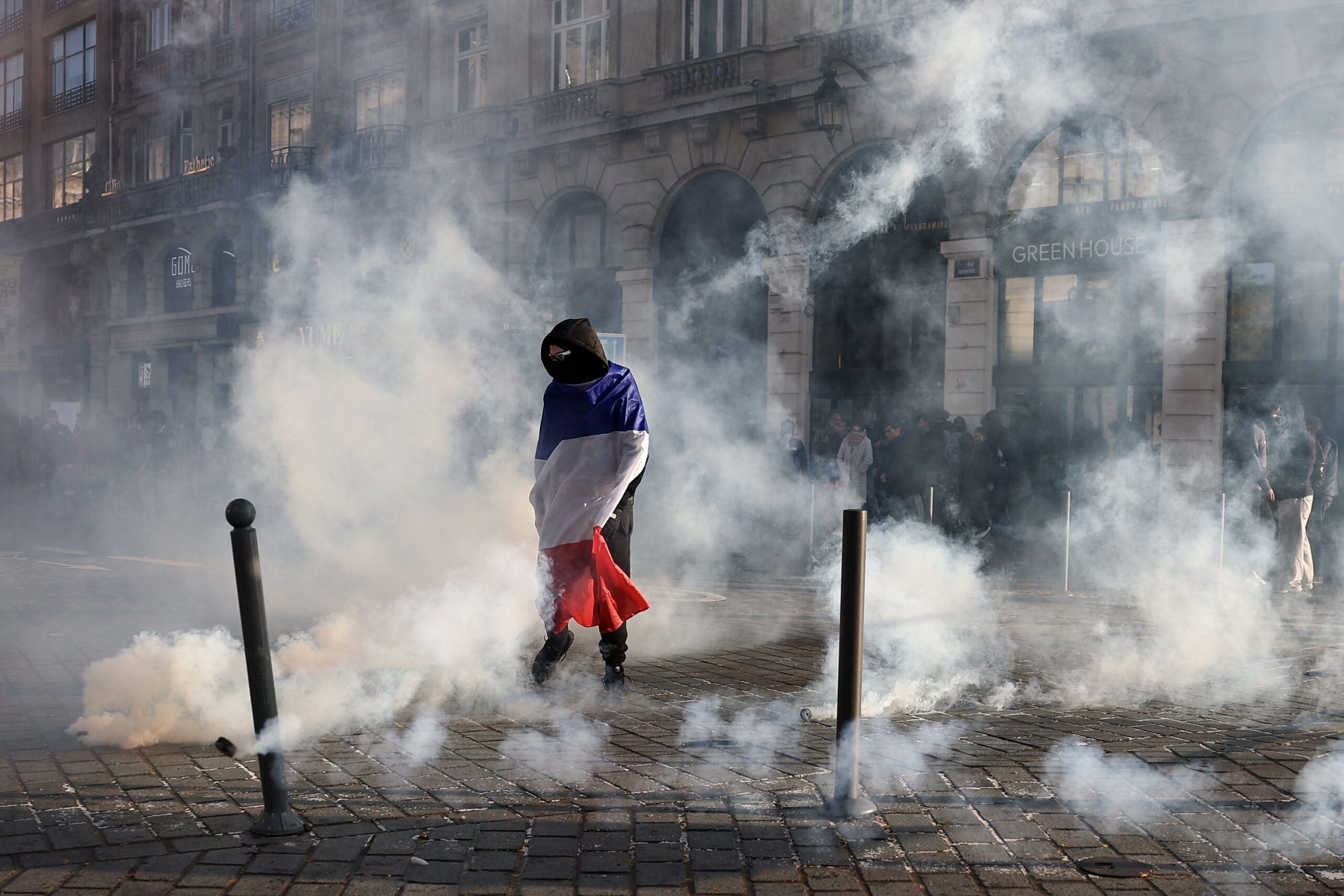
On October 17, a day of largely peaceful nationwide protests morphed into chaotic scenes of looting and destruction: Limoges’s historic town hall went up in flames; shops were ransacked, and protesters were maimed for life.
Opportunistic looters joined in, alongside young protesters from various backgrounds. According to an internal Justice Ministry document, 68% of the 186 people jailed between October 18 and 21 were 25 or younger, while 52% had no previous criminal record. Nearly half were classified as looters.
Failures in the police response help explain how the situation got so out of control. Behind the tear gas and smoke, however, lies a shift in how some French protesters operate.
Over the past decade, some have developed a savoir-faire for confrontation. As riot police have adapted their tactics and weapons, demonstrators have become adept at anticipating police maneuvers and exploiting gaps in security. Methods once associated with organized radical militants have spread to a younger generation.
How Black Bloc tactics spread
They tend to gather at the front of demonstrations, dressed head to toe in black, masked and hooded earning them the moniker “Black Bloc.”
The groups first appeared in Germany in the 1980s. Associated with anarchist and anti-capitalist movements, Black Bloc is not an organization with a formal leadership; it’s a set of protest tactics. These methods gained prominence in France during the 2016 labor protests before spreading further during the Yellow Vest movement.
Identities are concealed and participants often act as a group, sometimes attacking symbols of capitalism such as luxury stores.
These type of protesters are often referred to as “casseurs” too, from the verb “casser,” meaning “to break” – a broad term that can be applied to anyone who vandalizes property regardless of their ideological beliefs.
“Many young people who aren’t originally from the ultra-left are now adopting Black Bloc tactics,” said Thierry Vincent, an expert on radical-left movements. “It’s a way of protesting that doesn’t shock many young people anymore.”
One Black Bloc tactic involves small, highly mobile groups breaking away from the main march, forcing police to spread their forces thin, making it harder for them to respond in a coordinated way. That was on display a fortnight ago when a group of protesters attempted to reach the Elysee Palace, drawing riot police away from the demonstration. The maneuver worked. Police resources were stretched, and it contributed to officers being overwhelmed that day.
It’s not just their methods that have caught on. There’s also a wider willingness to confront the police.
Hugo Melchior, a historian and left-wing activist who has attended demonstrations in the northwestern city of Rennes for two decades, saw that firsthand. In the sea of masked protesters, he spotted small groups of students apparently unconnected to militant organizations.
“Sometimes it was four young friends, high-school or university students, probably affiliated with no network or organization, who had simply decided to come and demonstrate that way, with the intention of fighting,” he told CNN.
Melchior had not seen so many people prepared for confrontation since the 2006 student riots.
Police tactics are changing too
Historically, France’s crowd control doctrine was all about keeping protesters at a distance. That’s become more difficult to maintain because of violent confrontations.
Olivier Cappe, a former riot police officer with 25 years of experience who now represents the UN1TÉ police union, said officers are now facing threats from Molotov cocktails, fireworks mortars, pétanque balls and other projectiles.
“Automatically you have to send your officers out to intervene, possibly charge and confront people,” Cappe said. “That’s where people get injured.”
Staff shortages compound the problem. Cappe estimates France lacks around 800 specialist riot police officers.
“The principle of French crowd control is numbers,” he said. “The more numerous you are, the more imposing you look. The more imposing you look, the less you intervene.”
Outnumbered officers may resort more quickly to weapons such as rubber bullet launchers, he suggested. During both the Yellow Vest movement and more recently the student protests, officers without specialist crowd control training have been deployed with devastating results.
Early in the protests, a 14-year-old boy suffered smashed teeth and a fractured jaw after a police officer fired a tear gas canister at close range, striking him in the face. A 16-year-old lost the use of an eye after being struck by a rubber bullet, while a 15-year-old lost a hand to a stun grenade, prompting the interior minister to temporarily suspend the grenade’s use.
Cappe acknowledges that more forceful policing can deepen the problem. When officers confront violent groups alongside students, younger demonstrators may later come to identify with those being targeted.
For student Lucas Petit, who identifies with the far left, the debate goes beyond whether violence is justified. It’s about what that violence is intended to achieve. He’s not shocked by attacks on symbols of capitalism, as he feels these acts of violence can serve a political purpose.
“These are not acts of violence for the sake of violence,” he told CNN. “They have a very specific political message.”
On Wednesday French President Emmanuel Macron described the escalation of violence as a collective failure.
“I don’t think any high school student started pushing for their demands expecting to suffer such terrible consequences,” he said, adding police officers hadn’t signed up to face such violent confrontations either.
When asked about a 15-year-old student who lost his hand, Macron said nothing could justify what had happened and reiterated his call for calm.
Restoring peace to the streets is a tall order right now when so many feel that the government’s efforts to contain the violence, such as curfews, protest bans and a heavy police presence, violate their sacred right to protest and amount to a denial of democracy.
And with this no longer just being a student movement, as trade unions and Yellow Vests join in, voicing grievances over the cost of living and calling on Macron to go, the anger is unlikely to subside anytime soon.
On top of all that, France is heading into a deeply divisive presidential election in April, raising the stakes even further.
A winter of discontent may lie ahead, with another protest on Saturday and a major demonstration scheduled for November 5, raising fears of a repeat of the extreme violence seen on October 17.
The-CNN-Wire
™ & © 2026 Cable News Network, Inc., a Warner Bros. Discovery Company. All rights reserved.
CNN’s Lucie Lepellec contributed to this report
