The US economy grew just 0.7% last quarter, ahead of a potentially destabilizing war with Iran
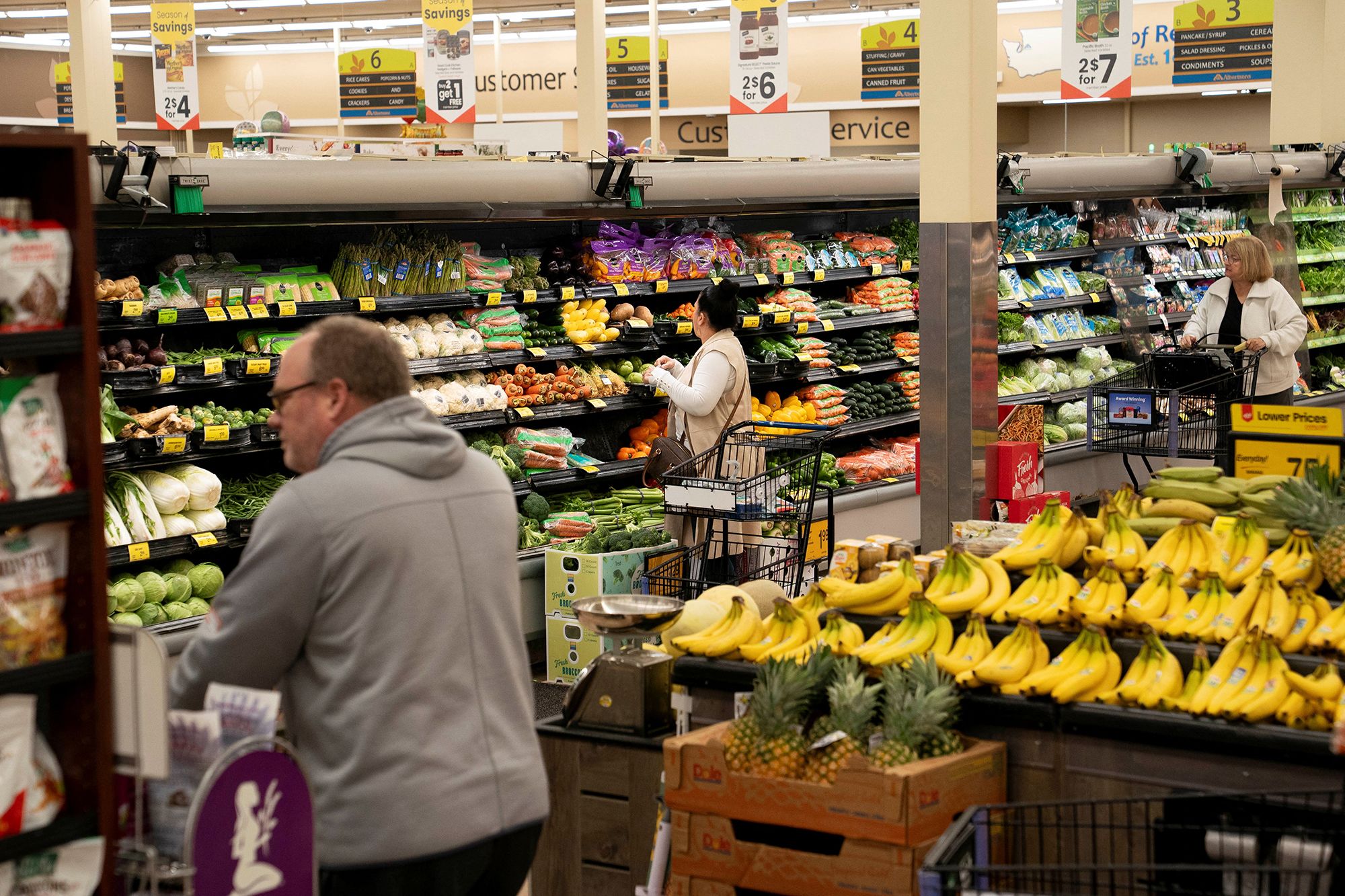
Food shoppers browse for groceries ahead of the Thanksgiving Day holiday at an Albertsons supermarket in Redmond
By Bryan Mena, Elisabeth Buchwald, CNN
Washington (CNN) — The US economy was on shaky footing even before President Donald Trump plunged the United States into a war with Iran, a battery of new data released Friday showed.
At the end of last year, economic growth was anemic, the Commerce Department said Friday, dragged down by the historic government shutdown. Economists widely expect most of those losses to be recouped in the current quarter stretching from January through March.
But America still has an inflation problem, according to January figures released Friday — one that will likely worsen if the Iran war continues to disrupt global energy markets. Consumers are already taking notice of higher prices at the pump, set to weigh on America’s already-weak economic mood.
The crosscurrent of intensifying price pressures and ongoing fragility in the labor market puts Federal Reserve policymakers in a difficult spot as they’re set to convene in just a few days to set interest rates.
“The full impact on the US economy and financial markets from the Iranian conflict remains highly fluid and uncertain,” said Kathy Bostjancic, chief economist at Nationwide, in an analyst note Friday. “The longer the conflict and disruptions persist, the larger the possible negative hit to business and consumer confidence from increased uncertainty that would inflict further drag on economic activity.”
The overall picture
US gross domestic product, the broadest measure of economic output, expanded at an annualized rate of 0.7% in the October-through-December period, the Commerce Department said Friday in its second estimate. That’s down sharply from the 1.4% rate initially reported, and a much slower pace than the 4.4% in the third quarter.
The latest estimate revised several output categories lower, including exports, consumer spending and government outlays. The biggest downward revision was to exports, which moved down to -3.3%, much lower than the -0.9% reported in the first estimate.
The government shutdown was still the biggest factor subtracting from GDP in the fourth quarter, shaving off 1.16 percentage points. Economists widely expect most of those losses to be recouped in the current quarter that stretches from January through the end of March.
“The big downward revision in GDP is a gut check going into this energy crunch, increasing the risk of stagflation,” David Russell, global head of market strategy at TradeStation, wrote in analyst note Friday.
The fourth quarter capped a tumultuous year for the US economy as Trump waged a bid to reshape global trade and businesses ramped up investments in AI while slamming the brakes on hiring. The economy expanded just 2.1% in 2025, the weakest annual pace since 2020, and before that, since 2016.
Now, though, the US economy is currently staring down the effects of Trump’s war on Iran, which has already sent oil prices skyrocketing and pushed up prices at the pump for Americans, with more inflation pain expected if the war broadens or is prolonged.
The latest sentiment survey from the University of Michigan released Friday showed that the Iran war has already begun to take a toll on consumers. Sentiment declined about 2% this month to a reading of 55.5, according to a preliminary reading.
“Interviews completed prior to the military action in Iran showed an improvement in sentiment from last month, but lower readings seen during the nine days thereafter completely erased those initial gains,” Joanne Hsu, the survey’s director, said in a release.
The labor market remains shaky
The oil shock comes as the US labor market remains in a precarious state, with employers shedding 92,000 jobs in February as the unemployment rate rose to 4.4% from 4.3%.
But new data released Friday by the Bureau of Labor Statistics suggests employers are still looking to hire more workers, with 400,000 new job openings in January, compared to December.
However, layoffs and discharges ticked up slightly, by 183,000 to 2.1 million in January. That’s according to the latest Job Openings and Labor Turnover report.
A weakening labor market helped the Fed lower rates three times last year, but unless conditions deteriorate, Fed officials may hesitate to lower rates anytime soon because of the looming threat of higher prices due to the expanding conflict in the Middle East.
The engine of the economy isn’t hitting the brakes (or the gas)
With looming concerns about job security, Americans’ appetite for spending isn’t growing.
A separate report from the Commerce Department on Friday showed consumer spending held firm at a 0.4% rate in January from December, according to Personal Consumption Expenditures data. That matters for the broader economy, since spending represents about two-thirds of US economic activity.
Friday’s revised GDP data also showed that inflation-adjusted consumer spending in the fourth quarter was 2%, which is lower than the previously reported 2.4% gain.
On the inflation side, the Fed’s preferred inflation gauge, the PCE price index, showed slight improvement in January. On an annual basis, it grew at 2.8% versus 2.9% in December. And on a monthly basis, inflation was up 0.3% compared to 0.4% in December.
“This is only going to head higher as the energy shock comes through,” Sonu Varghese, chief macro strategist at Carson Group, wrote in commentary issued Friday. “An already large headache for the Federal Reserve is going to turn into an even larger one, and it’s likely the Fed will not cut rates in 2026 and may even start talking about rate hikes later this year.”
The-CNN-Wire
™ & © 2026 Cable News Network, Inc., a Warner Bros. Discovery Company. All rights reserved.
