Taliban allows men to beat their wives as long as they don’t break bones or leave open wounds
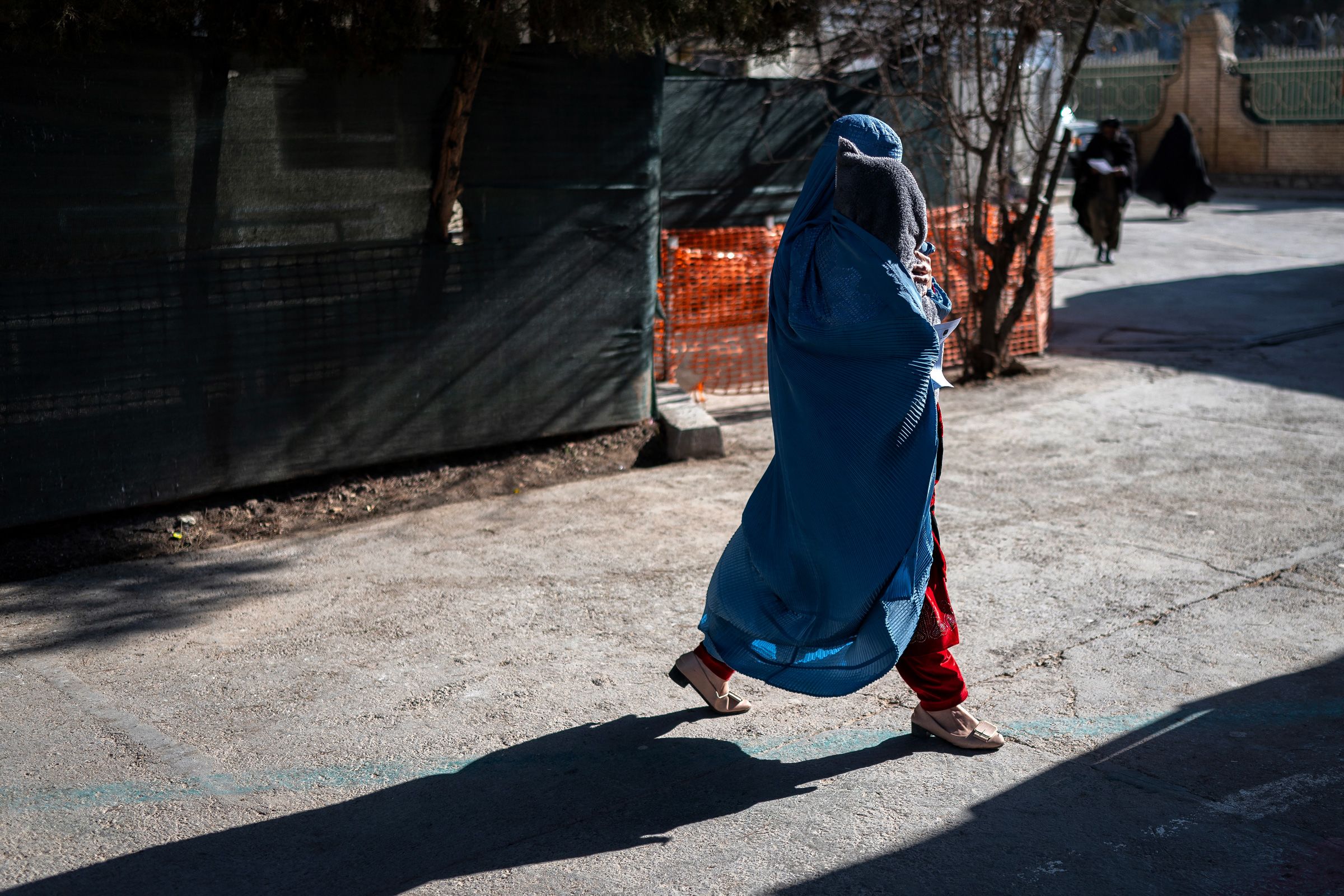
Women in Afghanistan have seen their rights steadily degraded since the Taliban returned to power.
By Mick Krever, Isobel Yeung, CNN
(CNN) — Taliban authorities in Afghanistan have issued a draconian decree that makes sodomy punishable by death and allows men to beat their wives so long as they don’t break bones or leave visible, lasting wounds.
Human rights campaigners have decried the move as “devastating” and warned that women’s recourse to justice would be further curtailed.
“The men have the right to rule completely the women,” rights activist Mahbouba Seraj told CNN from Kabul. “His word is the word of law – that’s it.”
The decree was issued last month but has only recently come to international attention after it was leaked to the Afghan rights group Rawadari, which published it in the original Pashto. The Afghan Analysts Network then translated the document into English.
The punishments it details have already been widespread in Afghanistan, but this is the first time that they have been so clearly codified since the United States and its allies withdrew from the country in August 2021, allowing the Taliban to return to power.
The Taliban insists that all its rulings are in line with Islamic Sharia law and have religious legitimacy.
“If a husband beats his wife so severely that it results in a broken bone, or an open wound, or a black and blue wound appears on her body, and the wife appeals to a judge, then the husband will be considered an offender,” the code says, according to the Afghan Analysts Network’s translation. “A judge should sentence him to 15 days’ imprisonment.”
The punishment for animal abuse is more severe. The decree says that anyone who forces animals like dogs or cockerels to fight should be sentenced to five months in prison.
The decree also permits a father to punish their child for, among another things, failing to pray. The punishment for a teacher who so severely beats a student that a bone is broken is to be removed from their job.
Given that women in Afghanistan are prohibited from leaving the home without a male guardian, activists say the new law will prevent women from seeking justice even in cases of severe physical violence. Afghanistan’s Sharia Law also dictates that a woman’s testimony is worth half that of a man.
Women have seen their rights steadily degraded since the Taliban returned to power. Women are banned from almost all work outside the home. UNICEF estimates that more than two million girls and women have been shut out of education by the Taliban’s ban on them attending secondary school and university.
The UN’s top human rights official, Volker Türk, told the Human Rights Council in Geneva Thursday that the decree was “legitimizing violence against women and children, and warned that “Afghanistan is a graveyard for human rights.
“Afghanistan’s women and girls face extreme gender-based discrimination and oppression that amounts to persecution,” Türk said. “The system of segregation is reminiscent of apartheid, based on gender rather than race.”
The decree also clamps down on dissent. Anyone who insults Taliban leader Hibatullah Akhundzada must receive 39 lashes and a year in prison, while anyone who “humiliates senior officials” is subject to six months’ imprisonment and 20 lashes.
Rawadari, the activist group that first circulated the decree, said it was “incompatible with even the most basic standards of fair trial, including the principle of equality before the law.”
The death penalty, too, is sanctioned for a wide range of crimes.
A judge or imam may sentence to death anyone who spread doctrines “contrary to Islam” and anyone who “persistently” engages in theft, homosexuality, heresy, sorcery, or anything other than vaginal sex.
Activists say that the way the doctrine defines a “Muslim” leaves wide latitude for authorities to punish religious minorities in what is a diverse country.
“I cannot tell you the number of calls I’m getting from women who are desperate all over Afghanistan,” Seraj, the women’s rights activist, told CNN. “When you have these kinds of laws being implemented and the husband can decide on everything then forget it. At least before there was a fear of the courts, judges. Women would complain. Now what?”
CNN’s Kara Fox contributed to this report.
The-CNN-Wire
™ & © 2026 Cable News Network, Inc., a Warner Bros. Discovery Company. All rights reserved.
