Saudi airport struck again a day after deadly attack killed at least 12 and wounded hundreds
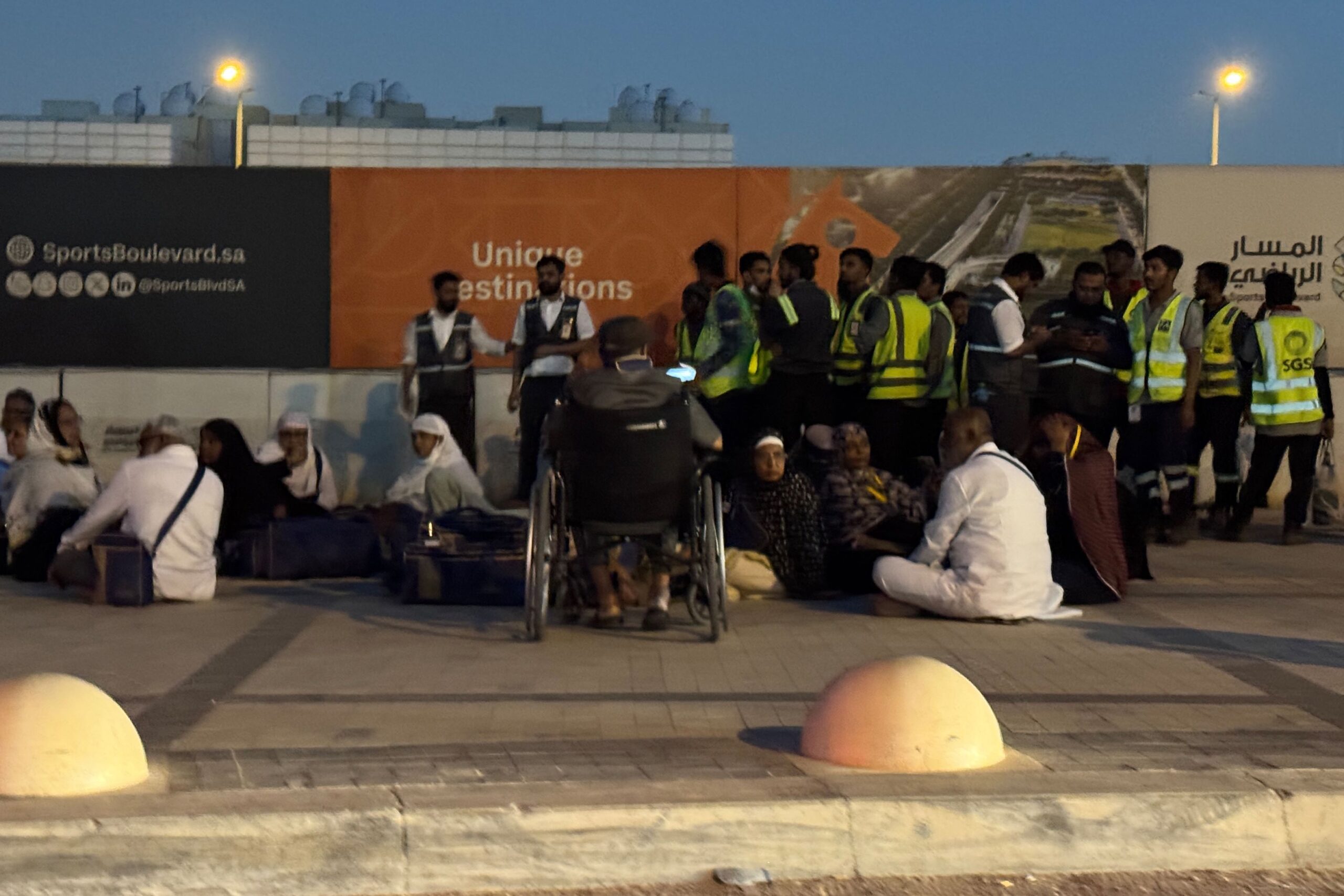
People gather outside a metro station on the road to King Khalid International Airport in Riyadh

By Laura Sharman, Tim Lister, Mohammed Tawfeeq, CNN
(CNN) — Riyadh’s King Khalid International Airport came under fresh attack Sunday, a day after a Houthi missile strike killed at least 12 people and wounded hundreds in Saudi Arabia’s deadliest attack in more than a decade.
The strike on Sunday caused a fire in Terminal 4, according to the spokesman for the Saudi-led coalition against the Houthis in Yemen.
Saudi Arabia’s civil aviation authority later said the attack on the airport resulted in injuries and that officials were continuing to assess the damage and verify the safety of airport facilities. Later, Saudi air defenses intercepted a cruise missile in the airport’s vicinity.
The latest attack followed Saturday’s missile strike on the airport, which Saudi authorities said killed four Saudis, two Bangladeshis, an American, an Egyptian, a Jordanian, a Syrian, a Palestinian and a Sudanese, and wounded 309 others. The Indian Embassy in Riyadh said Sunday that an Indian citizen injured in the strike later died.
That attack forced the airport to be closed until at least late Sunday, leading to the cancellation of more than 600 flights.
The Houthis claimed responsibility for the latest attacks including Saturday’s strike, saying they were carried out in response to an intensified Saudi air campaign in Yemen that claimed children and women were among casualties. In a statement, the Houthi-controlled armed forces said Saudi warplanes had launched 124 airstrikes over the previous 24 hours and threatened to continue targeting airports and other sites inside the kingdom.
The Houthis also claimed to have targeted King Fahd International Airport in Dammam. Saudi Arabia’s General Authority of Civil Aviation later confirmed that the airport had come under attack Sunday evening and said authorities were assessing damage and conducting safety inspections.
Following Saturday’s attack, US President Donald Trump said he was considering joining Saudi strikes against the Houthis in Yemen, having previously resisted Saudi requests for direct military intervention.
The attack was part of a series of strikes on King Khalid International Airport this week. Six people were killed and dozens more wounded in attacks on the airport between Tuesday and Thursday, according to Saudi authorities.
One traveler at the airport during Saturday’s attack told Reuters news agency they saw something fly across the sky outside before part of the ceiling near a departure gate collapsed.
Another recalled hearing an explosion before seeing several people lying wounded on the ground.
An eyewitness video released by Reuters showed large boards and debris strewn across the terminal floor, with people moving through a dust-filled hall.
King Khalid International Airport, Saudi Arabia’s second-busiest, serves the capital, Riyadh, a city of about eight million people.
The US, UK, Spain and Canada are among countries warning their citizens against using the airport.
Saturday’s incident has exposed vulnerabilities in the kingdom’s defense capabilities as it wages an air campaign in support of Yemen’s internationally recognized government, which is fighting the Houthis on the ground.
With Iranian assistance, the Houthis have built up a large arsenal of missiles, including ballistic weapons, as well as a range of drones.
A Houthi military statement Sunday reiterated a warning to all airlines and travelers against using Saudi airports and airspace, “as they are vulnerable to targeting… with the exception of Mecca and Medina airports.”
“Saudi Arabia will bear responsibility for any failed attempts to intercept” missiles, the Houthi statement said, and it would continue responding to “blockades with blockades, and escalation with escalation.”
The group has also warned airliners against using Saudi airspace.
‘We’ll make a decision’
Trump said Saturday he plans to speak with Saudi Crown Prince Mohammed bin Salman following the attack.
“They’re able to defend. The Saudis are good fighters. But I think the attack was a terrible thing,” Trump said when asked whether Saudi Arabia could defend itself against the Houthis.
Asked outside the White House whether Washington planned to join Saudi strikes on the Houthis, a militia aligned with US foe Iran, Trump told reporters: “We may. We’re going to look at it.”
“We just found out about the recent attack, so we’ll make a decision. We move very quickly.”
Last month, Trump rejected two appeals from Saudi Crown Prince Mohammed bin Salman for US strikes against the Houthis, CNN reported at the time.
US Secretary of State Marco Rubio confirmed a US citizen was among those killed and condemned the attacks as showing “a blatant disregard for innocent civilian life,” in a post on X.
The US Embassy in Riyadh in a statement on Sunday said it was “deeply saddened” by the deaths in Saturday’s strike. The embassy extended condolences to the families of those killed and wished a “full and swift recovery” to those injured.
Wounded people, including some in critical condition, were rushed to hospitals Saturday by ambulance and helicopter, people familiar with the matter told Reuters.
UN Special Envoy for Yemen Hans Grundberg called the attacks “a grave escalation” that poses a serious threat to regional security, in a post on X.
United Nations Secretary-General António Guterres condemned the latest strike and said “attacks on civilians and civilian infrastructure are a violation of international law,” also writing on X.
Saudi miscalculations
The civil war in Yemen flared up once again this summer and significantly intensified last month, after years of relative calm.
In retaliation for a Saudi blockade on the Yemeni capital Sanaa, the Houthis announced in July they would target Saudi shipping in the Red Sea, and began a campaign of missile attacks against Saudi infrastructure, including oil refineries.
Last month, they conducted a lightning offensive along Yemen’s Red Sea coast, capturing the port of Mocha and closing in on Taiz, Yemen’s third-largest city.
That led the Saudi-backed Yemeni government based in Aden to launch a major offensive, but it has struggled to retake much ground.
Saudi Arabia has for 11 years tried to contain the conflict on its southern border through military force and diplomacy – first waging war with the Houthis, then pursuing peace talks with them and restoring diplomatic talks with their backer, Tehran.
Despite the efforts, a series of miscalculations has left Riyadh exposed to further conflict in Yemen, experts say.
Saudi Arabia ended its longstanding partnership with the UAE late last year over its backing of a rival force in Yemen, misjudged Trump’s willingness to back it if it needed support, and struggled to organize disintegrated armed factions fighting the Houthis.
The escalation threatens Saudi Arabia’s broader ambitions to become an international destination for business and tourism.
On Sunday, the Saudi energy ministry said the World Petroleum Congress began as scheduled in Riyadh, but it’s unclear how many delegates are attending.
CNN’s Ibrahim Dahman, Michael Williams and Mostafa Salem contributed reporting.
The-CNN-Wire
™ & © 2026 Cable News Network, Inc., a Warner Bros. Discovery Company. All rights reserved.
