After oil increasingly left the Gulf, Iran is trying to regain its stranglehold on shipping
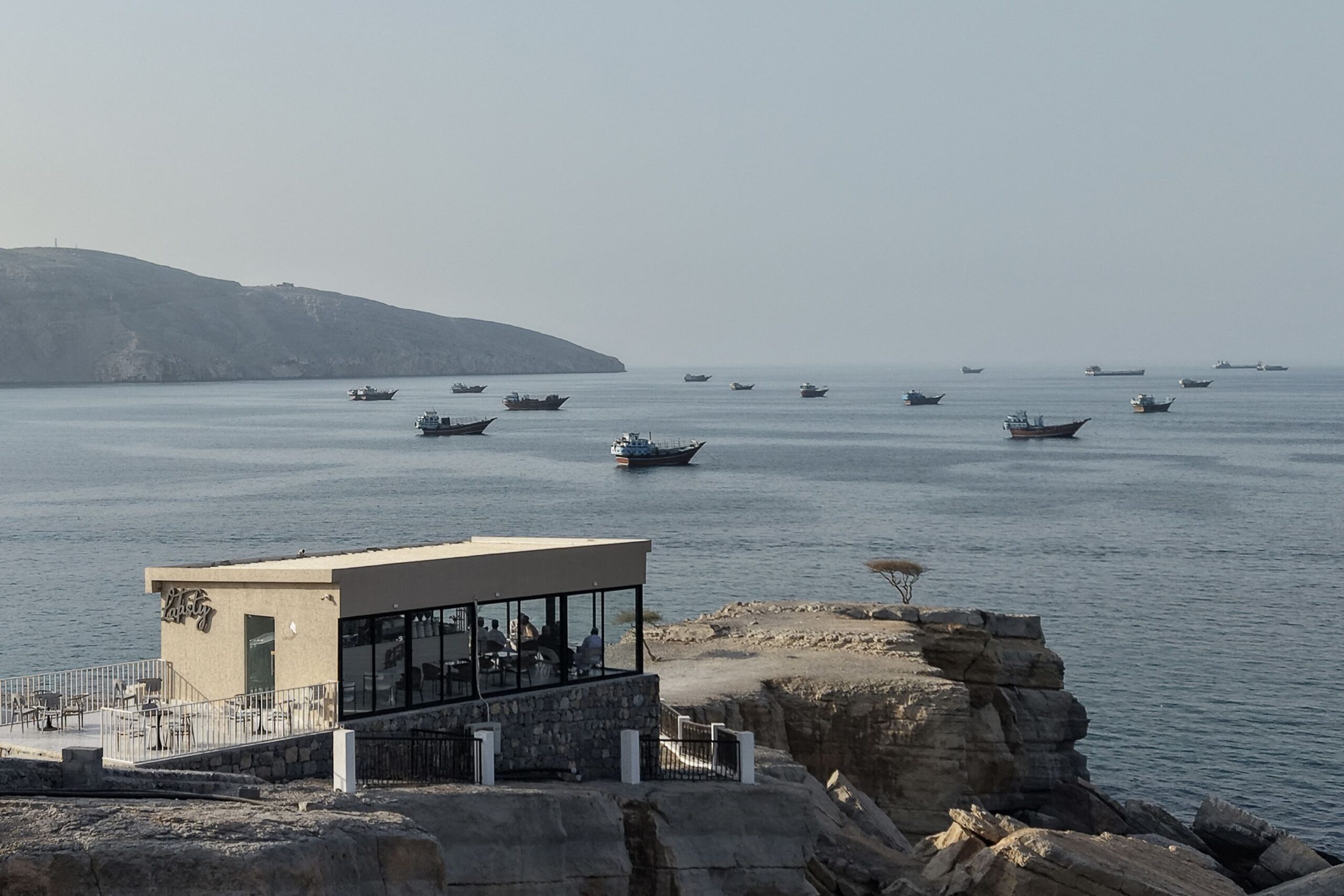
An aerial view shows ships anchored off the coast of Khasab in Oman's Musandam Governorate

By Tim Lister and Aida Karimi, CNN
(CNN) — Iran is stepping up attacks on tankers in the Strait of Hormuz and Persian Gulf in an effort to restore its leverage over the critical waterway.
More than a dozen strikes on shipping have occurred since the end of September, reducing the volume of oil transiting the strait and keeping crude prices above $100 a barrel.
US President Donald Trump announced Thursday that he has no plans to strike Iran before the midterm elections, where rising energy costs could play a part in his Republican Party losing the House of Representatives, the Senate – or both.
“We will not be attacking Iran at any time prior to the Midterm Elections to be held in the United States on November 3rd,” Trump declared on Truth Social, adding that the administration is “having productive discussions” with Tehran and that his main goal is to ensure the country does not obtain a nuclear weapon.
Tehran, however, is focused on Hormuz as a “strategic red line” and is broadening its target range in the Gulf.
Leverage over Hormuz is non-negotiable for Tehran as it weathers US pressure despite a sinking economy. But Washington has said that the principle of free navigation in international waters is inviolable, a stance echoed by Gulf states that rely on the strait for much of their trade.
In one of the latest incidents, the United Arab Emirates National Guard said Saturday it rescued 22 people after an oil tanker fire. Those rescued were Indian citizens – India is one of the largest suppliers of seafarers.
The UK Maritime Trade Operations (UKMTO), which tracks shipping incidents, has reported several other attacks in recent days.
On Sunday, six commercial vessels were reportedly struck in and around the strait – the highest number of incidents reported in a single day since the war started, according to shipping industry experts. Several incidents were reported late, highlighting that the full picture may take time to emerge.
It said the master of an outbound tanker reported it was struck Saturday by an unknown projectile in the Strait of Hormuz, causing a fire on board. UKMTO reported another attack in the same area on Sunday, which damaged the vessel. All crew members were reported safe.
The navy of Iran’s Islamic Revolutionary Guards Corps (IRGC) claimed on Saturday that a supertanker carrying crude oil suffered a massive explosion after striking a naval mine while attempting to leave the Strait of Hormuz through a route Tehran hadn’t authorized.
“No extra-regional power has the right to threaten, maintain a domineering presence, or interfere in it. The Strait of Hormuz is Iran’s strategic red line,” said the head of the IRGC, Ahmed Vahidi, in a post on X.
UKMTO said Sunday it had also received a report from several ships in UAE waters that they had been directed via VHF radio messages to move from their anchorages. Iran has avoided targeting the UAE recently.
Shipping analyst Ambrey said the IRGC Navy had issued a warning to six vessels anchored around 16 miles (25 kilometers) from the port of Ras al Khaimah in the UAE.
“The vessels were advised to heave up anchor, exit the area immediately, and transit to Dubai anchorage,” Ambrey noted.
Analysts say the rise in Iranian attacks and threats is in response to higher volumes of oil and petroleum products through the strait. They averaged about 13.1 million barrels per day at the end of September, according to Kpler, a marine data tracking service.
That’s just under 80% of the 17.1 million barrels that had traveled through the strait each day before the war broke out.
But flows appear to have slowed this month. Just seven tankers transited the Strait of Hormuz on Tuesday, less than half the seven-day average and the lowest number since July 23, Kpler data showed.
However, figures are sometimes revised higher after ships move through the strait, as many switch off their identification systems to avoid detection.
The US military continues to enforce a blockade on Iranian ports, as part of a strategy of maintaining economic pressure on Iran.
On Saturday, it disabled a cargo vessel in the Gulf of Oman after the ship’s crew ignored warnings and attempted to run the ongoing naval blockade against Iran.
“A U.S. military fighter jet struck the stern of Panama-flagged M/V Ocean Molica (also known as the “Arika Sun”) with a precision munition, fully disabling the ship’s propulsion without harming the crew,” US Central Command posted on X.
Analysts say the US blockade has been highly effective. September was the first month that Iran loaded no crude onto tankers since maritime data tracking service Kpler began monitoring Iranian exports in 2013.
Last week, Mohsen Rezaei, Secretary of Iran’s Supreme National Security Council, described the current economic situation as one of the most difficult periods the country has faced.
Tehran has insisted that if it can’t export its oil, its neighbors won’t be able to either. It believes it holds the initiative, given US shortages of air defense interceptors, and says its military posture has moved towards the offensive.
“Both the Americans and other countries should know: As we have said before, in a region where we cannot sell oil, no one else will be able to sell oil either. And if our security is not guaranteed, no infrastructure will be safe,” Iran’s chief negotiator Mohammed Bagher Ghalibaf, said late in September.
It now seems intent on turning that threat into reality.
The-CNN-Wire
™ & © 2026 Cable News Network, Inc., a Warner Bros. Discovery Company. All rights reserved.
