What caused the deadly train crash in Spain? What we know so far
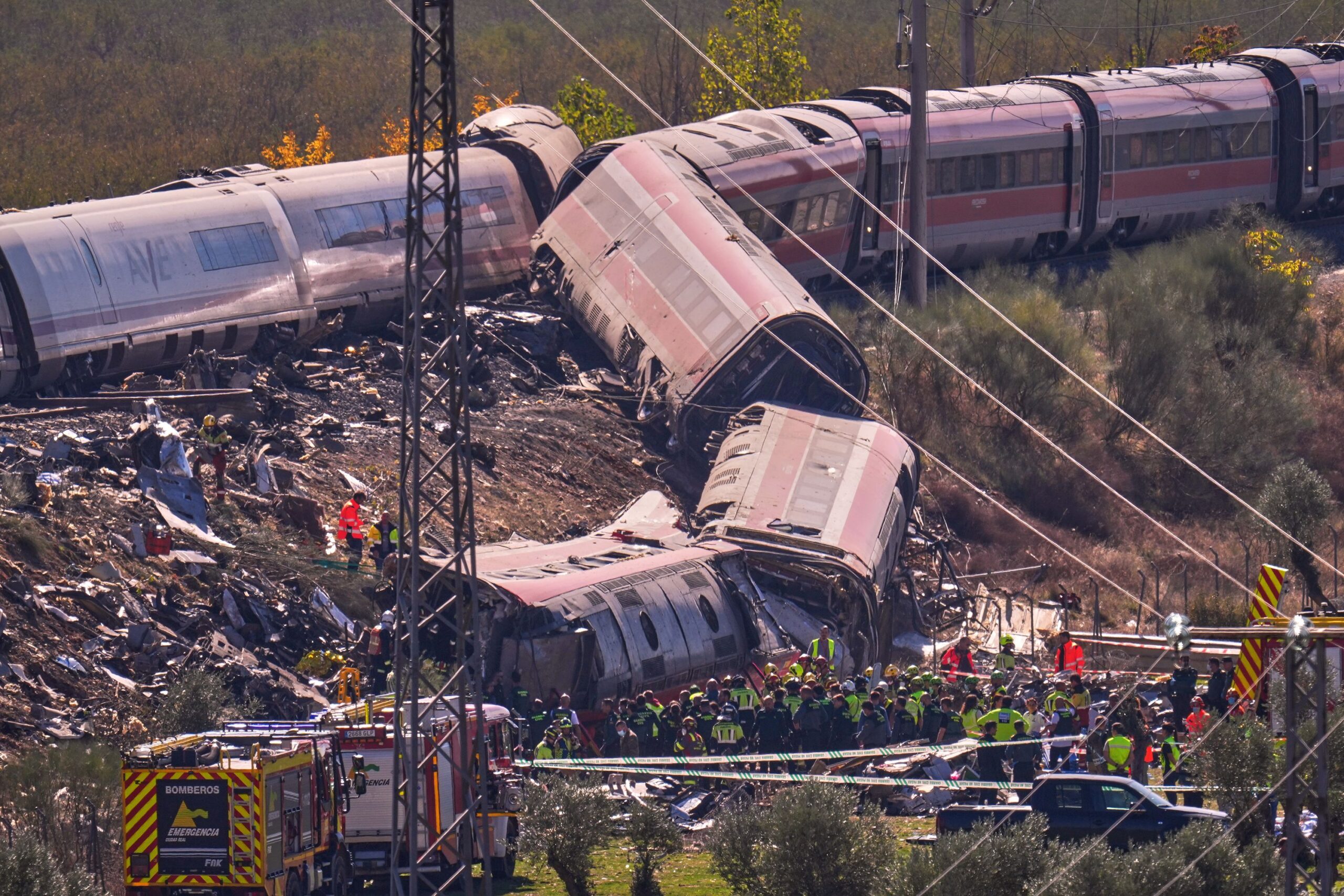
An investigation is underway and Spain's PM said negligence would be met with the "utmost firmness."

By Lauren Kent, CNN
(CNN) — Scores of people were killed after two trains collided in Spain on Wednesday, in a crash that authorities say was caused by both computer system failure and apparent human error.
At least 68 people were killed and more than 100 injured after one train rear-ended another train near the town of Urda, in Toledo province, on the high-speed line that connects Madrid and Seville.
One of the trains, operated by Spain’s national rail company Renfe, plowed into a stationary train operated by the private company Iryo, at a time when all train traffic in the area was disrupted due to a problem with the LZB train management safety system.
It marks the third deadly rail incident in Spain this year, following a major crash in January in Córdoba province in which more than 40 people died, and a crash near Barcelona that killed a train driver.
“Today, Spain is in mourning. All of Spain is in mourning,” said Prime Minister Pedro Sánchez from the scene of the crash on Wednesday, as he expressed his “full solidarity” with victims’ families.
What caused the collision?
Spain’s transportation minister Óscar Puente said that a computer system failure led to an issue with the safety system along a 63-kilometer (40-mile) stretch of track causing all trains in the area to be stopped automatically.
At that point, the state-owned company that manages Spain’s railways, ADIF, took manual command of the system and a decision was made to allow the high-speed Renfe train to continue southbound along the tracks despite a red light.
The Renfe train was authorized to proceed without any speed restrictions due to an erroneous order from a train controller. As a result, Puente said that between 8:36 a.m. and 8:52 a.m. local time, it resumed traveling at about 124 miles per hour, eventually colliding with the stationary Iryo train.
“There was a red signal prohibiting movement, yet the train was authorized to proceed,” the transportation minister said at a press conference on Wednesday. “It is a decision made under inexplicable circumstances.”
Among those who were killed, 24 were on the Renfe train, traveling from Madrid to Seville, and 44 were on the Iryo train, also going between Madrid and Seville.
Puente added that there will be a full investigation into the incident.
Sánchez said that “if there has been negligence, it will come to light. And if there have been failures in the safety system, they will be addressed with the utmost firmness.”
What have the passengers said?
Passengers told CNN that the moment of the crash on Wednesday was “very chaotic,” and people were immediately thrown out of their seats and on top of one another inside the carriages.
One surviving passenger said that three of the train cars in particular “were in terrible shape.”
“One was on fire, in another there were people trapped and crying,” said the passenger, who declined to give her name. “And then in the main one (impacted) – there were people buried under debris.”
Another passenger, Yoander, 25, said, “I was sleeping, and when I woke up I was already crashing into the seats in front of me.”
“I hit my face and my leg,” he told CNN’s producer on the ground. “I’m in pain, but there are people that need more help than I do.”
A woman who was traveling on the Renfe high-speed train also described “awful” scenes as people were thrown into the air.
Speaking to CNN, Patricia said her train had been stopped for about 20 minutes before the accident, with an announcement explaining there was a lot of traffic. “After that, we departed, and maybe not after even three minutes, there was a crash,” she said.
“Some people were hurled into the air… it was awful,” she said. “Some of the train structure got into our carriage, and our carriage wasn’t even the worst (affected).”
There were 151 passengers on the Iryo train and 393 passengers on the Renfe train, according to the latest update from the regional government of Castilla and La Mancha.
How have authorities responded?
Dozens of fire trucks, ambulances, and police cars rushed to the site of the crash in the immediate aftermath. The Spanish civil guard set up multiple tents for what amounted to a huge emergency response, according to CNN’s team on the ground. At least three helicopters were also at the site to assist with rescue operations.
Emergency responders have been combing through the rubble of some of the heavily damaged carriages of the Iryo train. Several carriages of the state-owned Renfe high-speed train were tilted on their side after coming off the rails.
Authorities moved passengers who did not have serious injuries away from the site via buses. Several passengers being bussed away had minor injuries, including cuts on their faces and around their eyes, and what appeared to be bloody noses.
The evacuated passengers included citizens of multiple nationalities, including Spain, Brazil and elsewhere, according to CNN’s producer at the scene. The US State Department has said “several” Americans were injured in the train collision.
The town of Urda, roughly five miles from the crash site, has received dozens of ambulances and emergency service vehicles, according to a second CNN team in the area. Red Cross workers operating out of the town’s sports center are treating the injured.
The Spanish Civil Guard announced that they have opened four offices in different Spanish cities to swiftly identify the victims of the crash.
Meanwhile, the regional government has urgently called for blood donations following the train crash, urging citizens to donate blood at sites in the cities of Alcázar de San Juan, Ciudad Real and Toledo.
What’s Spain’s rail safety record?
Prime Minister Sánchez said on Wednesday that “it’s clear that we have suffered two terrible tragedies involving high-speed rail in the same year,” acknowledging the other major crash in Córdoba province that killed more than 40 people in January.
The crash on Wednesday happened about 130 miles from the site of the January train disaster near the town of Adamuz, along the same high-speed rail route that runs between Madrid and Seville.
However, the cause of the train crash earlier this year was markedly different. That collision involved one train derailing due to a break in the track and crossing onto an adjacent track, according to Spain’s public broadcaster RTVE.
Prior to the Adamuz train disaster, Spain’s train drivers’ union, Semaf, had raised concerns about high speeds causing vibrations and subsequent wear and tear along high-speed railway lines, a source from the union told CNN at the time.
A third crash this year near Barcelona – which happened days after the Adamuz train disaster – involved a commuter train derailing on a day of heavy rainfall. That crash killed the driver and injuring dozens of passengers, according to the regional government of Catalonia at the time.
The successive incidents have raised concerns about Spain’s railway infrastructure, computer systems and the maintenance of both.
But prior to this year, European Union statistics show that Spain’s rail safety record was better than many other European countries.
In 2023, Spain had fewer than 1 railway deaths per one million inhabitants – giving it the best record in the EU at the time, according to a Eurostat report. Most railway deaths in the EU are a result of unauthorized people on the tracks, rather than incidents that kill passengers or staff inside the train, data shows.
CNN’s Catherine Nicholls, Michael Rios and Jack Guy contributed to this report.
The-CNN-Wire
™ & © 2026 Cable News Network, Inc., a Warner Bros. Discovery Company. All rights reserved.
