What caused the deadly train crash in Spain? What we know so far
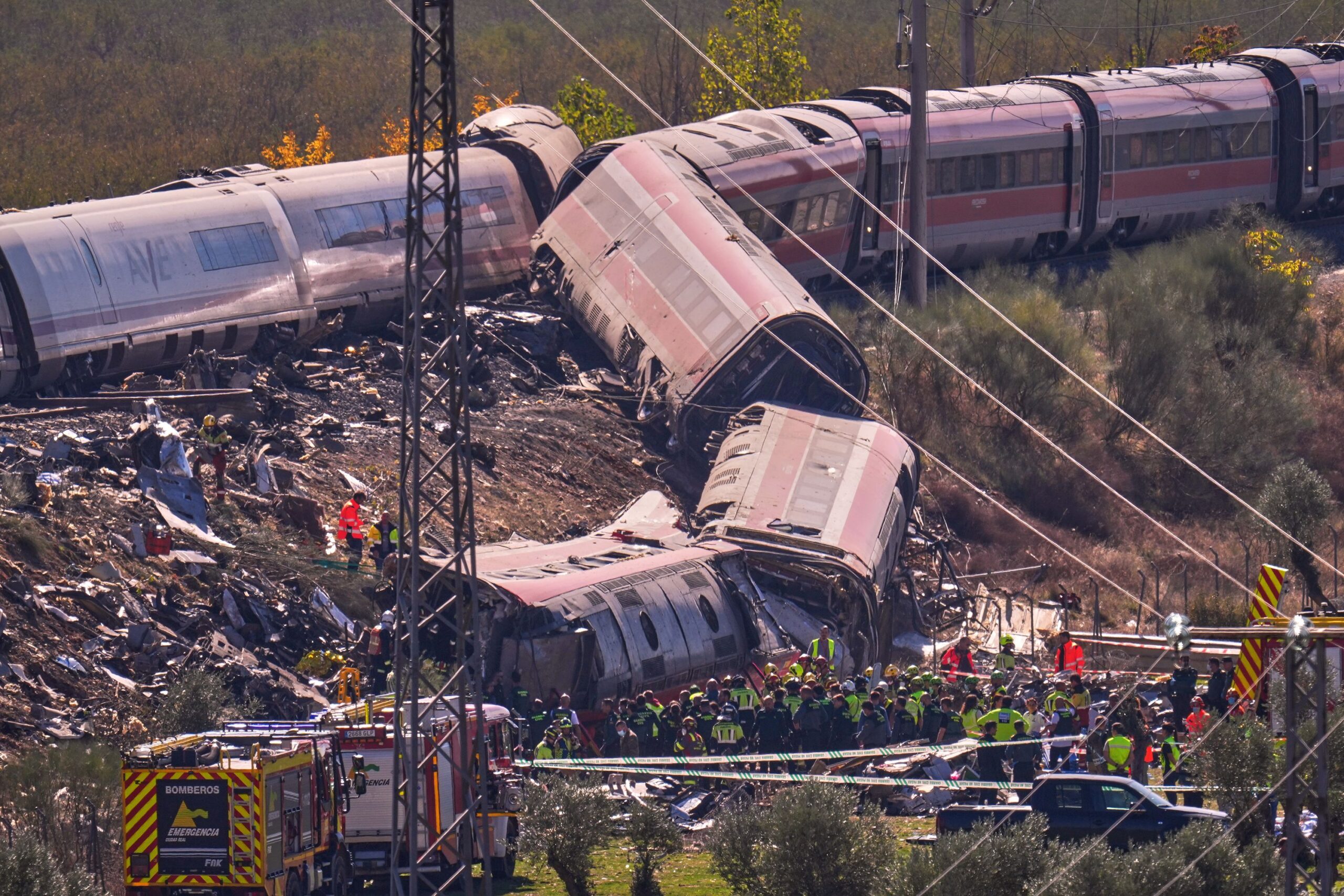
An investigation is underway and Spain's PM said negligence would be met with the "utmost firmness."

By Lauren Kent, CNN
(CNN) — Individuals from as many as 27 different countries may have died in this week’s high-speed train collision in Spain, the country’s prime minister said Friday, as the process to identify victims continued.
The deadly crash happened Wednesday after one train plowed into another near the town of Urda, in Toledo province, on the high-speed line that connects Madrid and Seville, killing at least 69 people and injuring over 100 others. Authorities say the incident was caused by both computer system failure and apparent human error.
One of the trains, operated by Spain’s national rail company Renfe, crashed into a stationary train operated by the private company Iryo, at a time when all rail traffic in the area was disrupted due to a problem with the LZB train management safety system.
It was the third deadly incident on the country’s rail network this year following a major crash in January in Córdoba province, in which more than 40 people died, and a crash near Barcelona that killed a train driver.
Spain’s Prime Minister Pedro Sánchez has announced an official mourning period from Thursday until Saturday.
What caused the collision?
Spain’s transportation minister, Óscar Puente, said a computer system failure led to an issue with the safety system along a 63-kilometer (40-mile) stretch of track causing all trains in the area to be stopped automatically.
At that point, the state-owned company that manages Spain’s railways, ADIF, took manual command of the system and a decision was made to allow the high-speed Renfe train to continue southbound along the tracks despite a red light.
The Renfe train was authorized to proceed without any speed restrictions due to an erroneous order from a train controller. As a result, Puente said that between 8:36 a.m. and 8:52 a.m. local time, it resumed traveling at about 124 miles per hour, eventually colliding with the stationary Iryo train.
“There was a red signal prohibiting movement, yet the train was authorized to proceed,” the transportation minister said at a press conference on Wednesday. “It is a decision made under inexplicable circumstances.”
Following Puente’s comments, Spanish trade union CSIF called on the transport minister to resign, saying: “We demand that the Government respect the investigation and the presumption of innocence for the head of traffic at ADIF.” CNN has approached Spain’s transport ministry for comment.
Audio recordings published in Spanish media reveal conversations between the train drivers and the controller in the moments leading up to the crash. The recordings appear to show that the Renfe train was given clearance to move, with the controller telling it to continue onward at “normal operation.”
In another recording, the driver of the Iryo train involved in the crash also receives the instruction to resume “normal operation.” Minutes later the driver reports that she is unable to restart her train and it is currently not moving.
The collision occurred while the Renfe train was traveling at a speed estimated to be between 160 km/h (nearly 100 mph) and 200 km/h (around 124 mph), according to AITAT, the independent body responsible for investigating the incident.
Passengers told CNN that the moment of the crash was “very chaotic,” and people were immediately thrown out of their seats and on top of one another inside the carriages.
One surviving passenger said that three of the train cars in particular “were in terrible shape.”
“One was on fire, in another there were people trapped and crying,” said the passenger, who declined to give her name. “And then in the main one (impacted) – there were people buried under debris.”
In total there were 151 passengers on the Iryo train and 393 passengers on the Renfe train, according to the latest update from the regional government of Castilla and La Mancha.
Of the 110 injured people who were taken to the hospital, 60 have been released, according to an update from the regional government on Thursday.
Puente added that there will be a full investigation into the incident.
Who were the victims?
Little is known at this stage regarding the identity of the victims. Identification efforts are ongoing while emergency staff continue to comb through the wrecked carriages at the crash site, where rescuers and cranes worked through the night under floodlights.
The Spanish Civil Guard announced that it has opened four offices in different Spanish cities to swiftly identify the victims of the crash. The Civil Guard said that the DNA of families is being gathered to aid this process. 67 missing persons reports have been filed in the wake of the accident, the force confirmed to CNN.
One mother, Rosario, told CNN she had provided DNA samples to help find her missing 32-year-old son, Francisco José, who was on board one of the trains. Rosario said her son had also been about to board one of the trains involved in the Adamuz crash in January, but eventually decided to buy a ticket for a later journey instead.
The Civil Guard announced that one of its own officers lost his life in Wednesday’s crash. Naming the victim as José Manuel, the police force offered its “deepest condolences” to his family, friends, and colleagues. A former Spanish minister, Fátima Báñez, was also killed, her People’s Party (PP) confirmed on Thursday.
In the wake of the crash more than 500 emergency personnel were deployed to assist with rescue operations, Spain’s interior ministry said, as well as at least three helicopters and several drones.
Authorities removed passengers without serious injuries away from the scene by bus. The evacuated passengers included citizens of multiple nationalities, including Spain, Brazil and elsewhere, according to CNN’s producer at the scene. The US State Department has said “several” Americans were injured in the train collision.
Portugal’s foreign ministry confirmed a Portuguese national died in the crash, adding that he had been a crew member on one of the trains involved.
A 24-year-old Spanish athlete is also thought to have lost her life. Long jumper Julieta Gallego competed for the Madrid-based track and field club AD Sprint. The Royal Spanish Athletics Federation (RFEF) announced her death, while her club said they were “heartbroken.”
Two Italian citizens remain missing, according to Italy’s foreign ministry, while another has safely made contact with Consular services.
Sánchez has said that the Spanish government will provide compensation for families of the victims.
What’s Spain’s rail safety record?
The crash on Wednesday happened about 130 miles from the site of the January train disaster near the town of Adamuz, along the same high-speed rail route that runs between Madrid and Seville.
However, the cause of the train crash earlier this year was markedly different. That collision involved one train derailing due to a break in the track and crossing onto an adjacent track, according to Spain’s public broadcaster RTVE.
Prior to the Adamuz train disaster, Spain’s train drivers’ union, SEMAF, had raised concerns about high speeds causing vibrations and subsequent wear and tear along high-speed railway lines, a source from the union told CNN at the time.
Spain’s train drivers held a pre-planned nationwide strike Thursday to call for stronger safety measures.
Speaking to reporters during the strike, SEMAF Secretary General Diego Martín called for a “rigorous and independent investigation” into the crash and criticized the leaking of audio from the control center as “alarming, disrespectful and irresponsible.”
A third crash this year near Barcelona – which happened days after the Adamuz train disaster – involved a commuter train derailing on a day of heavy rainfall. That crash killed the driver and injuring dozens of passengers, according to the regional government of Catalonia at the time.
The successive incidents have raised concerns about Spain’s railway infrastructure, computer systems and the maintenance of both.
But prior to this year, European Union statistics show that Spain’s rail safety record was better than many other European countries.
In 2023, Spain had fewer than 1 railway deaths per one million inhabitants – giving it the best record in the EU at the time, according to a Eurostat report. Most railway deaths in the EU are a result of unauthorized people on the tracks, rather than incidents that kill passengers or staff inside the train, data shows.
What will the impact be?
Wednesday’s fatal crash has sparked fresh criticism of Sánchez and the fallout from the disaster will likely impact his left-wing government just four weeks before national elections on November 29.
The incident has served to further erode public trust in Spain’s railway infrastructure and creates another major setback for a government already marred by recent corruption scandals and the Ceuta mass migrant crossing crisis earlier this year.
Protests erupted in Madrid on Wednesday night, with people calling for the resignation of both Sánchez and Transportation Minister Puente.
Puente has refused to resign, saying on Friday that that would be the “easy thing” to do and instead vowing to fulfil his duty of determining exactly what happened.
Videos from the demonstrations showed some protesters holding signs saying “corruption kills” and “leave!” alongside images of Sánchez.
CNN’s Sophie Tanno, Vasco Cotovio, Sol Amaya, Catherine Nicholls, Michael Rios, Billy Stockwell, Jack Guy, Pau Mosquera and Duarte Mendonca contributed to this report.
The-CNN-Wire
™ & © 2026 Cable News Network, Inc., a Warner Bros. Discovery Company. All rights reserved.
