Fire truck in LaGuardia runway collision had no transponder, limiting tower’s ability to track it, NTSB says
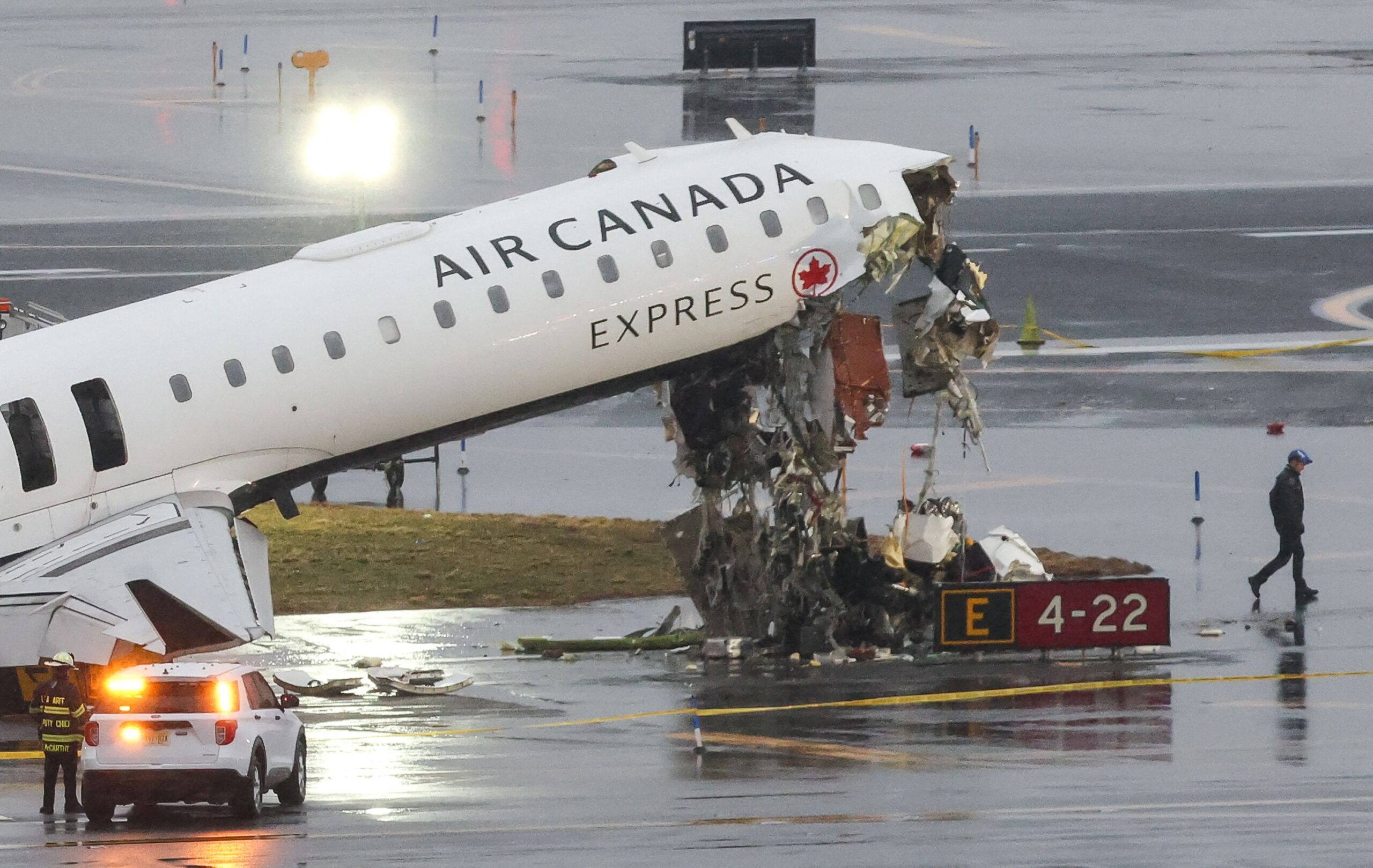
An Air Canada Express CRJ-900 sits on the runway after colliding with a Port Authority fire truck (L) at LaGuardia Airport in New York.

By Zoe Sottile, CNN
(CNN) — A fire truck involved in Sunday’s deadly collision with an Air Canada plane at New York’s LaGuardia Airport was not equipped with a transponder — technology that helps air traffic controllers identify and track vehicles on the airfield — the National Transportation Safety Board said Tuesday.
Also, the airport’s surface detection equipment – ASDE-X – didn’t generate an alert ahead of the collision “due to the close proximity of vehicles merging and unmerging near the runway,” which resulted “in the inability to create a track of high confidence,” NTSB chairwoman Jennifer Homendy said.
Those were among the latest details announced Tuesday in the investigation into Sunday night’s collision, in which officials said the plane, which was landing and had just touched down, struck the truck on a runway that the truck was crossing.
The collision killed the plane’s pilot and copilot and injured dozens of people, including a flight attendant who was thrown from the plane while still strapped to her seat.
Both Canadian and American authorities are investigating the collision, which follows several high-profile aviation disasters in 2025 — including a shocking midair collision between a military helicopter and a commercial jet near Washington, DC, which left 67 dead — that brought scrutiny to the industry and triggered calls for reform.
The crash marks the first deaths at LaGuardia, the New York area’s third-busiest airport, in 34 years, Port Authority Executive Director Kathryn Garcia said Monday.
Sunday night’s collision brought operations at the airport – a major transit hub that served over 32 million passengers last year – screeching to a halt before it reopened Monday afternoon. Hundreds of flights have been cancelled at the airport, and runway 4 will remain closed until 7 a.m. Friday, according to a public notice from the FAA.
The closure came as a Department of Homeland Security funding shutdown has led to TSA staffing shortages and massive lines at airports across the country, with some passengers reporting hours spent waiting to go through security.
There’s no evidence the shutdown contributed to the collision; air traffic controllers, unlike TSA agents, are still paid during this partial shutdown.
Here’s what we know about the collision.
Plane struck fire truck on runway
Just three minutes elapsed between when the Air Canada flight was cleared to land and when it collided with the fire truck.
Air Canada Flight 8646 took off from Montreal-Trudeau International Airport shortly after 10:30 p.m. ET Sunday night. The plane, with four crew members, arrived at LaGuardia about an hour later, according to the flight tracking site FlightRadar24. It was cleared to land at around 11:35 p.m.
The fire truck, meanwhile, was on its way to help a separate plane that had reported an emergency on the other side of the airport.
United Flight 2384, scheduled to depart for Chicago, aborted its takeoff due to a warning light at around 11:18 p.m. As controllers worked to find a gate for that plane, the pilots reported an odor in the cabin had sickened the flight attendants, according to a LiveATC.com recording of air traffic control audio.
The crew of the fire truck – a Port Authority aircraft rescue and firefighting vehicle – was dispatched to respond to the United flight. The fire truck crew requested permission to cross the runway where the Air Canada aircraft was landing.
Just 10 seconds after granting permission for the fire truck to cross, a controller seemed to reverse course and told it to stop, the audio indicates.
“Stop. Stop. Stop. Stop, truck 1. Stop,” he said.
The collision took place about 11:38 p.m., just three minutes after the Air Canada flight was cleared to land. The controller can then be heard directing other aircraft to abort their landings and “go around,” noting the runway was closed.
The Air Canada plane was traveling about 104 mph just before it hit the fire truck, according to the last data point collected before the collision by Flightradar24.
On Tuesday, the NTSB laid out a summary of events captured on the plane’s cockpit voice recorder during the recording’s final three minutes. All times below count down to the end of the transmission:
- 2 minutes, 17 seconds before the end of the recording – The LaGuardia tower cleared the Air Canada flight to land on Runway 4. The crew then adjusts and sets the wing flaps to prepare for landing. The landing gear was already lowered
- 11 minute, 26 seconds – An electronic callout indicated the plane is 1,000 feet above the ground.
- 1 minute, 3 seconds – An airport vehicle made a radio transmission to the tower, but that transmission was “stepped on” by another radio transmission. The source of who made that transmission has yet to be identified.
- 54 seconds – The flight crew acknowledged the plane was 500 feet above the ground and on a stable approach.
- 40 seconds – The tower asked which vehicle needed to cross a runway.
- 28 seconds — The fire truck makes a radio transmission to the tower. The tower acknowledged the transmission, and the truck requested to cross Runway 4 at taxiway Delta.
- 20 seconds – The tower cleared the fire truck to cross Runway 4 at taxiway Delta.
- 19 seconds – An electronic callout indicated the plane is 100 feet above the ground.
- 17 seconds — The truck read back the runway crossing clearance.Over the next four seconds, the plane continues its descent.
- 9 seconds — The tower instructed the fire truck to stop.
- 8 seconds — The plane’s landing gear can be heard touching down on the runway.
- 4 seconds — The tower again instructed the fire truck to stop.
- 0 seconds — The recording ends.
Chaos and fear on board
Inside the plane, there was chaos as the flight landed and collided with the truck.
“We went down for a regular landing; we came in pretty hard. We immediately hit something,” said Jack Cabot, one of 72 passengers aboard the flight traveling from Montreal.
“It was just chaos in there,” Cabot said. “Everybody was hunkered down and everybody was screaming pretty quickly.”
Another passenger, Rebecca Liquori, described a “very loud boom” as the plane struck the vehicle.
“Everybody just jolted out of their seats,” Liquori, who had taken a one-day trip to Canada for a baby shower, recalled. “People hit their heads, people were bleeding.”
Both Liquori and Cabot said without any direction from crew members, passengers decided on their own to open the emergency exit and flee the plane.
Video captured by Cabot shows passengers standing on the wing of the aircraft as they exit the plane.
At one point, the aircraft can be seen slowly tilting upward as debris hangs from its front.
“All passengers come this way, come this way,” someone can be heard saying on a loudspeaker.
‘I messed up,’ controller says in audio recording
Eighteen minutes after the plane collided with the fire truck, an air traffic controller in the tower appeared to say to a pilot on the ground radio frequency: “I messed up.”
The exchange took place with a Frontier Airlines pilot waiting to return to the gate who saw the crash.
“That, that wasn’t good to watch,” the pilot said in audio recorded by LiveATC.net.
“Yeah, I know. I tried to reach out to them,” the noticeably distraught controller said. “We were dealing with an emergency earlier. I messed up.”
The pilot responded, “nah man, you did the best you could.”
The air traffic communications will be a part of the Federal Aviation Administration and National Transportation Safety Board’s extensive investigation into the cause of the crash. Determining the root cause of an accident can take a year or longer and often involves multiple contributing factors.
The NTSB is expected to provide an initial readout Tuesday on staffing levels in the LaGuardia air traffic control tower at the time of the collision, NTSB spokesperson Eric Weiss told CNN.
On Monday, US Transportation Secretary Sean Duffy disputed claims that only one controller was in the tower at the time of the crash.
The National Air Traffic Controllers Association, the labor union representing controllers, did not provide comment when reached by CNN.
Pilot and copilot killed
The Air Line Pilots Association called the deaths of the pilot and copilot a “profound tragedy” in a statement.
“These pilots dedicated their careers to the safe transport of passengers, and we are all thinking of their families, loved ones, and colleagues at Jazz Aviation during this devastating time,” Capt. Jason Ambrosi, ALPA president, said in the statement.
The union said its accident investigation team is heading to assist the NTSB and is providing support to pilots and families involved.
FAA Administrator Bryan Bedford said the pilots were “young men at the start of their careers” at a news conference Monday.
Both pilots died from blunt force injuries, and the manner of death was accidental, according to New York City’s office of the chief medical examiner, citing autopsies. The office did not release their names.
The pilot was Antoine Forest, according to the Toronto Star, which cited a family member, Jeannette Gagnier.
The copilot was Mackenzie Gunther, according to the college where he earned a degree and Canadian media outlets CTV and CBC. Gunther was the flight’s first officer and died in the collision, Seneca Polytechnic in Toronto said in an online post.
Gunther graduated from Seneca Polytechnic’s honors bachelor of aviation technology program in 2023, school spokesperson Cam Gordon told CNN Tuesday. Flags on campus will be lowered to half-staff Tuesday to honor Gunther, the school said.
Gunther joined Jazz Aviation, the operator of the Air Canada Express flight, right after graduation, according to the school.
Dozens injured
More than 43 people were hospitalized and “many” have since been released, according to Garcia, the head of the Port Authority.
In a video released Monday afternoon, Air Canada’s CEO said the final number of casualties remains unclear.
“We are working with authorities to confirm the number of injuries and if there are any other fatalities,” Air Canada President and CEO Michael Rousseau said.
The two firefighters in the truck, identified Monday as Sgt. Michael Orsillo and Officer Adrian Baez were both hospitalized, Garcia said, adding that one was expected to be released Monday afternoon, while the other would be kept overnight for observation.
Other Port Authority firefighters witnessed the crash and quickly began “evacuating the passengers, securing their safety while not knowing if their fellow officers in Truck 1 were dead or alive,” the Port Authority Police Benevolent Association said in a statement.
One flight attendant who survived the crash was found outside the aircraft – still strapped in her seat, a law enforcement source told CNN.
The attendant was identified as Solange Tremblay by her daughter, Sarah Lépine, in an interview with CNN affiliate TVA Nouvelles. Lépine said her mother suffered multiple fractures, was taken to the hospital and will undergo surgery for a broken leg.
“It’s all a miracle,” her daughter said. “At the moment of impact, her seat was ejected more than 100 meters from the plane. They found her and she was still strapped in her seat. She had a guardian angel who was looking right at her. It could have been so much worse.”
Investigators checking plane’s recorders for data
Canadian and US officials are working closely together on the investigation into the collision, Canadian Prime Minister Mark Carney said Monday, calling the collision “deeply saddening” in a post on X.
Both the US and Canadian transportation safety boards are deploying investigative teams to the crash site, officials said Monday.
Additionally, Duffy and Bedford were headed to the airport Monday morning, Bedford said on X.
He extended his thoughts and prayers to the victims of the crash and their families. Bedford also said the FAA will continue to support the NTSB in its investigation.
At a Monday news conference, NTSB chairwoman Jennifer Homendy said investigators hope to know soon if recorders in the plane have usable data.
Earlier Monday, Port Authority, which runs the airport, and other emergency responders cut a hole in the roof of the plane to retrieve the flight data recorder and cockpit voice recorder, she said. The NTSB verified that the cockpit voice recorder was not damaged.
The scene was littered Monday with wreckage from the collision: There is a “tremendous amount of debris” on the runway and “hazardous material” on the fire truck that was hit, Homendy said.
Days of travel delays
Sunday’s collision comes as air travel passengers across the country are already facing eye-popping wait times – with passengers even waiting outside the terminal, or in parking garages, at some airports.
The lapse of DHS funding has left TSA officers working without pay, and more than 400 officers have quit outright, according to Lauren Bis, acting assistant secretary for public affairs with the Department of Homeland Security.
The Trump administration has dispatched ICE agents to 14 airports Monday, in what it says is a bid to alleviate the TSA staff shortage. It’s unclear what roles the agents are performing.
At LaGuardia, stranded passengers camped out in the terminal overnight waiting for word on if and when they would be able to continue their journeys.
On Tuesday, about 20% of the flights scheduled to or from LaGuardia were canceled as the investigation pushed on. A similar number of flights have already been canceled at the airport for Wednesday, and an FAA notice says the runway where the collision occurred will remain closed until 7 a.m. ET Friday.
“We’re learning this information as they’re (the airlines) learning it,” Katie Rojas, a traveler intending to fly to Chicago, told CNN on Monday before the airport reopened. “Every few hours last night, everything was changing.”
Another passenger hoping to make it to Chicago, Diana Cruz, said she was grateful for her safety: She and Rojas had been originally booked on the United Airlines flight that reported the warning light and the strange odor.
“Just kind of glad that we’re all safe now that we have learned about it,” Cruz said. “Because it could have been us, it could have been anyone at this point.”
The-CNN-Wire
™ & © 2026 Cable News Network, Inc., a Warner Bros. Discovery Company. All rights reserved.
CNN’s Alisha Ebrahimji, Pete Muntean, Lauren Mascarenhas, Chris Boyette, Aaron Cooper, Paula Newton, Shimon Prokupecz, Carolyn Sung, Martin Goillandeau, Karina Tsui, Gloria Pazmino, Sara Smart, Leigh Waldman, Joel Williams, Hanna Park, Cindy Von Quednow, Sarah Dewberry and Andi Babineau contributed to this report.
